Climate Action


Supporting the Sustainable Development Goals (SDGs)


Goals and Performance Highlights
Goals
The Company is committed to achieving a 40% reduction in Scope 1 and Scope 2 organizational greenhouse gas emissions compared to BAU (Business As Usual) by 2030, and has a long-term goal of becoming a Carbon Neutral organization by 2050 for Scope 1 and 2.
The Company aims to reduce annual greenhouse gas emissions (Scope 1 and 2) from the 2024 base year GHG emission of 12,092 tCO2e.

And to support the monitoring of progress in reducing greenhouse gas emissions, the Company has prepared an Organizational Greenhouse Gas Inventory in accordance with the GHG Protocol Corporate Accounting Standard, covering Scope 1 and Scope 2 emissions, and continuously disclosing historical data for 3 years to enable stakeholders to transparently monitor emission trends and evaluate the effectiveness of the Company's greenhouse gas reduction measures.
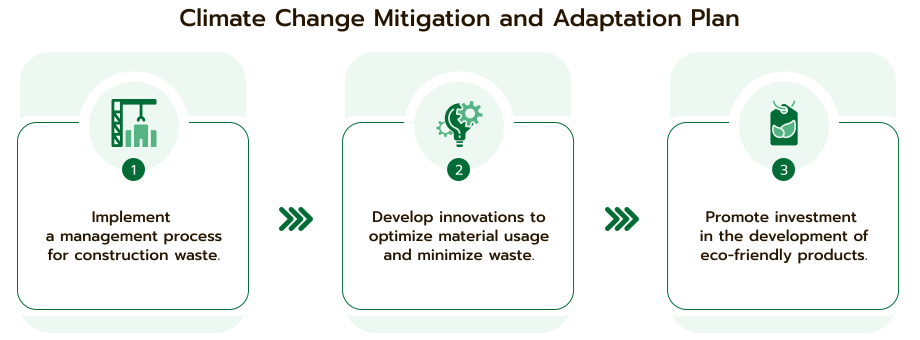
Commitment, Challenge and Opportunity
The real estate business is one of the sectors affected by climate change, making it a crucial factor inevitably influencing the restructuring of the real estate industry.
The Company recognizes that climate change is a strategic risk that may impact asset value, supply chains, and long-term operating costs. Therefore, the Company has established Climate Change policies and strategies to support greenhouse gas emission reduction and adaptation to climate impacts, in line with international standards such as TCFD, GRI, and the FTSE ESG Model, as well as Thailand's climate policy direction.
As the impacts are becoming increasingly severe and evident due to climate change and rising global average temperatures, residents face extreme heat conditions, leading to increased energy costs. This also includes the rising frequency of severe natural disasters such as flash floods, severe storms, earthquakes, etc., which directly affect buildings and the long-term costs of repairing and maintaining assets.
The increasing severity of these impacts leads to risks that must be managed carefully, such as a decrease in property values in high-risk areas and the trend of carbon taxation potentially affecting construction costs. Furthermore, the changing consumer behavior, which places greater importance on environmentally friendly housing, presents a crucial challenge that the Company must adapt to promptly, as failure to do so could lead to a loss of market competitiveness.
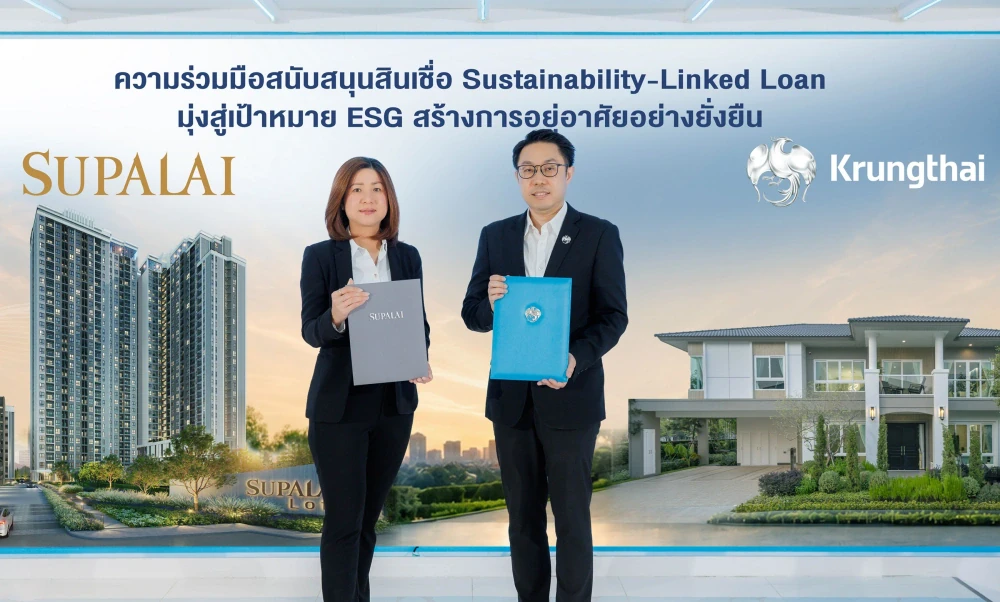
However, amidst these crises and risks, there are also significant opportunities for the Company to adapt proactively and create new innovations, such as designing buildings that rely on passive design, utilizing clean energy technologies to reduce electricity costs for residents, and developing climate-resilient projects. This not only helps reduce greenhouse gas emissions but also adds value to products as a leader in sustainability. Seizing these opportunities also allows the Company to access lower-cost green finance and instills confidence in stakeholders that all projects developed by the Company are built to truly grow alongside a sustainable world.
Governance Structure
Board Oversight of Climate Change
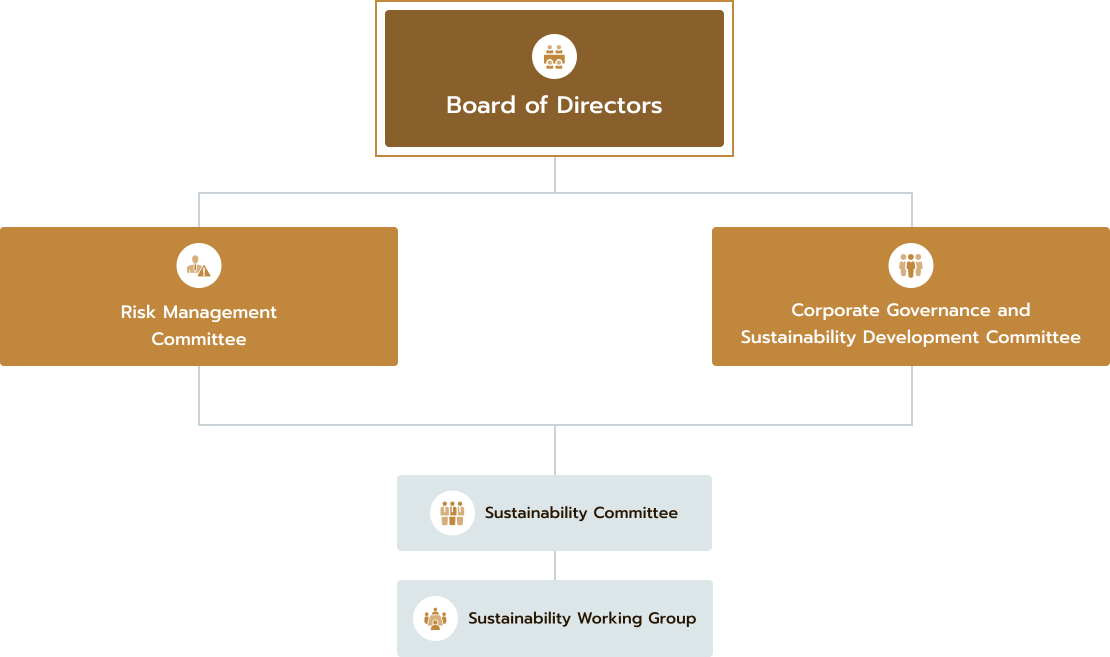
The Company aims to enhance ESG transparency by establishing a clear governance structure under the Board of Directors, ensuring accurate, reliable, and internationally compliant data disclosure. The sustainability governance structure is organized into three levels: Board Level, Management Level, and Operational Level.
Board Level The Board of Directors has approved the charters for the sub-committees involved in Climate Change management, as follows:
- Audit Committee Oversee the accuracy, transparency, and reliability of ESG data before disclosure to stakeholders, and ensure internal audits cover ESG issues.
- Corporate Governance and Sustainable Development Committee Set direction, strategy, and monitor the organization's ESG operations.
- Risk Management Committee Analyze Climate Risk and Nature-related Risks, and oversee risk assessment according to TCFD guidelines.
Management Level
- Sub-Committee on Risk Management and Sustainability Committee is overseen by Mr.Tritecha Tangmatitham, Chairman of the board and Managing Director. which plays a crucial role in setting strategic direction and overseeing the organization's climate change management in alignment with the vision, policies, and business objectives defined by the Board of Directors. It also implements improvements to work processes based on the recommendations of the Risk Management Committee and the Corporate Governance and Sustainable Development Committee, ensuring consistency with their views. It integrates Climate Change issues into ESG operations, risk management, and organizational decision-making processes, while monitoring, evaluating, and providing recommendations on impact reduction and adaptation to climate risks. continuous climate
Operational Level
- Sustainability Working Group Appointed by the Managing Director, playing a crucial role in driving climate change operations the organization's climate at the operational level. It is responsible for analyzing, planning, and systematically integrating Climate Change issues into the work processes of each department. The working group collects and manages data on greenhouse gas emissions, climate risks and opportunities, and monitors performance in climate change mitigation and adaptation to align with the organization's sustainability policies and goals. Furthermore, it plays a role in continuously reporting progress, risk issues, and policy recommendations to management and the Sustainability Committee, serving as a crucial mechanism to enhance the organization's readiness for climate change and support long-term sustainable growth.


Strategies and Management Approaches
Policy and Commitment
The Company recognizes climate change as a significant strategic risk for the real estate business. Therefore, it is committed to supporting climate change mitigation by establishing a "Climate Change Management Policy" that aligns with international standards and Thai regulations. It also continuously supports operations consistent with national climate policies and directions, aiming to contribute to driving impact reduction and fostering sustainability at the industry and overall economic levels.
Climate Change Management Policy
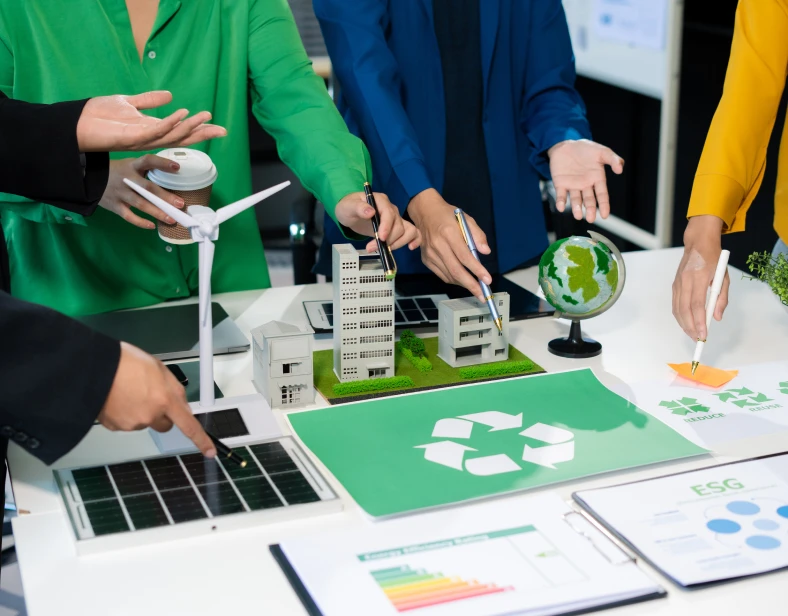
This policy establishes guidelines for the Company and its personnel to manage climate change and global warming factors arising from operational processes, ensuring compliance with Company regulations and international standards. It focuses on creating transparent and verifiable work processes and fostering understanding among all levels of personnel to sustainably reduce environmental impacts. The sub-policies are divided into two main parts as follows:
1. Energy Management
The Company focuses on enhancing energy efficiency at every stage of the business value chain, from construction processes and managing company-owned buildings to overseeing energy use in open spaces. Energy consumption data is continuously collected and reported for analysis, leading to strict guidelines for reducing energy use in products and operational processes. Additionally, independent external verifiers are engaged to certify data accuracy in accordance with international standards.
2. Greenhouse Gas Management
To achieve its goal of becoming a low-carbon organization, the Company has implemented a comprehensive greenhouse gas management system, as follows:
- Risk Management and Strategy A committee has been established to specifically define strategies and manage sustainability. The risk management department is tasked with analyzing opportunities and impacts from climate change across various timeframes to integrate them into the Company's overall risk management plan.
- Data Assessment and Analysis The Company prepares reports on both direct and indirect greenhouse gas emissions (Scope 1, 2, and 3), and calculates the carbon intensity per revenue to monitor operational efficiency.
- Target Setting and Innovation Simulating potential future events or scenarios to assess how climate change will impact the business or organization, and setting clear quantitative targets, divided into medium-term targets by 2030 and long-term targets by 2050. Additionally, it promotes research and development of environmentally friendly products and considers using financial instruments such as Internal Carbon Price to incentivize carbon emission reduction.
- Information Disclosure and Collaboration The Company focuses on disclosing climate-related financial information in its annual report, following international standards (TCFD). It also fosters collaboration with external organizations and implements the "Supalai Sang Dee" project to enhance its capacity for sustainable adaptation to climate change.
In addition, the Company emphasizes participation in business networks related to sustainable urban development and climate change to support the development of industry standards and public policies concerning Climate Change. The Company is a member of business organizations and professional networks such as the Thai Real Estate Association, the Thai Condominium Association, the Thai Chamber of Commerce and Board of Trade of Thailand, and FIABCI-Thai (International Real Estate Federation).
Such participation promotes the exchange of knowledge in sustainable real estate development and supports the establishment of industry-level standards for energy-efficient building design and greenhouse gas emission reduction.
Policy on Climate Change Management
Strategies and Management Approaches
The Company has a systematic climate change governance structure, integrating climate change risk management within the framework of the Task Force on Climate-related Financial Disclosures (TCFD). This covers both Physical Risk and Transition Risk, enabling comprehensive identification, prevention, and response to impacts. Define Risk Appetite to control risk exposure within manageable limits and emphasize proactive prevention. Furthermore, it identifies development opportunities such as designing and constructing with Green & Sustainable Design concepts, utilizing energy-saving technologies, increasing green spaces in projects, and developing products that meet the demands of environmentally conscious consumers. These initiatives will create competitive differentiation and enhance long-term sustainable value.

Risk Assessment and Climate Adaptation & Mitigation
The Company integrates climate risk assessment into its overall organizational risk management process. In 2025, real estate development projects continue to expand nationwide, with projects already developed in over 29 provinces. The Company has assessed severe climate change risks and opportunities, managing them according to the principles of the Task Force on Climate-related Financial Disclosures (TCFD), as follows:
Physical Risk
Flash Floods and Severe Typhoons
Impacts/Opportunities and Risk Management Measures
Impact
Flash floods can disrupt operations, or storms may damage construction project areas, directly leading to loss of company revenue, as well as impacting personnel safety and infrastructure.
Opportunities
Development of safety technology and innovations. Alert systems build confidence and attract safety-conscious customers.
Adaptation & Mitigation
- Develop emergency response plans for flash floods and severe typhoons, such as evacuating employees and those in high-risk areas to safety. Shut down electrical systems and potentially hazardous equipment. Contact relevant authorities such as rescue units and hospitals.
- Business continuity plan to manage construction disruptions with minimal impact, such as practicing evacuation plans and simulated responses, and purchasing insurance to mitigate natural disaster risks.
Earthquakes
Impacts/Opportunities and Risk Management Measures
Impact
Structural damage can halt construction work. Buildings and structures may be damaged, incurring high repair costs.
Opportunities
- Project development, designing homes and buildings to withstand vibrations, reducing repair costs in crises.
- Collaboration with contractors or partners to develop innovative construction materials resistant to vibrations, leading to increased revenue.
Adaptation & Mitigation
- Design and construct according to earthquake-resistant standards.
- Install early warning systems
- Develop emergency plans and conduct evacuation drills in simulated scenarios.
- Purchase property insurance to protect asset value.
Water Risk (Water Stress / Drought)
Impacts/Opportunities and Risk Management Measures
Impact
Properties located in coastal or low-lying areas face increased flood risk, which may lead to a decrease in property value and higher insurance costs.
Opportunities
Develop sustainable projects with natural disaster-resistant designs and create green spaces for water retention, meeting the demands of customers seeking new potential locations.
Adaptation & Mitigation
Designing protective infrastructure such as natural buffers, seawalls, and selecting sustainable construction materials, as well as planning project layouts to limit development in high-risk areas.
Rising Sea Levels
Impacts/Opportunities and Risk Management Measures
Impact
Properties located in coastal or low-lying areas face increased flood risk, which may lead to a decrease in property value and higher insurance costs.
Opportunities
Develop sustainable projects with natural disaster-resistant designs and create green spaces for water retention, meeting the demands of customers seeking new potential locations.
Adaptation & Mitigation
Designing protective infrastructure such as natural buffers, seawalls, and selecting sustainable construction materials, as well as planning project layouts to limit development in high-risk areas.
Employee Health and Occupational Hygiene (Waves Heat)
Impacts/Opportunities and Risk Management Measures
Impact
Rising average temperatures and accumulated heat pose health risks to outdoor workers, making them susceptible to heat-related illnesses such as heatstroke.
Opportunities
Adoption of robots to replace human labor, reducing labor costs and operational expenses.
Adaptation & Mitigation
- Well-ventilated rest areas
- Provide clean drinking water stations, at least 2-3 liters per person per day.
- Attire and equipment, such as safety helmets with sun-protective brims. First Aid Training
Transition Risk
The Company has a plan to address Transition Risks associated with the shift to a low-carbon economy, arising from changes in policies, laws e.g., carbon taxes or green building standards enforcement, technology, evolving customer demands e.g., demand for energy-efficient homes or the transition to environmentally friendly construction technologies, and reputation, should the Company fail to adapt promptly to societal trends.
Scenario Analysis
The Company has assessed the potential financial impacts of climate change risks and opportunities through Scenario Analysis, in accordance with TCFD (Task Force on Climate-related Financial Disclosures) standards. This assessment references data from scientific teams who conducted studies using models to forecast impacts with RCP 2.6 and RCP 4.5 (RCP: Representative Concentration Pathways, which are models of future greenhouse gas emissions between 2006 – 2300) to predict impacts in 2050, as follows:
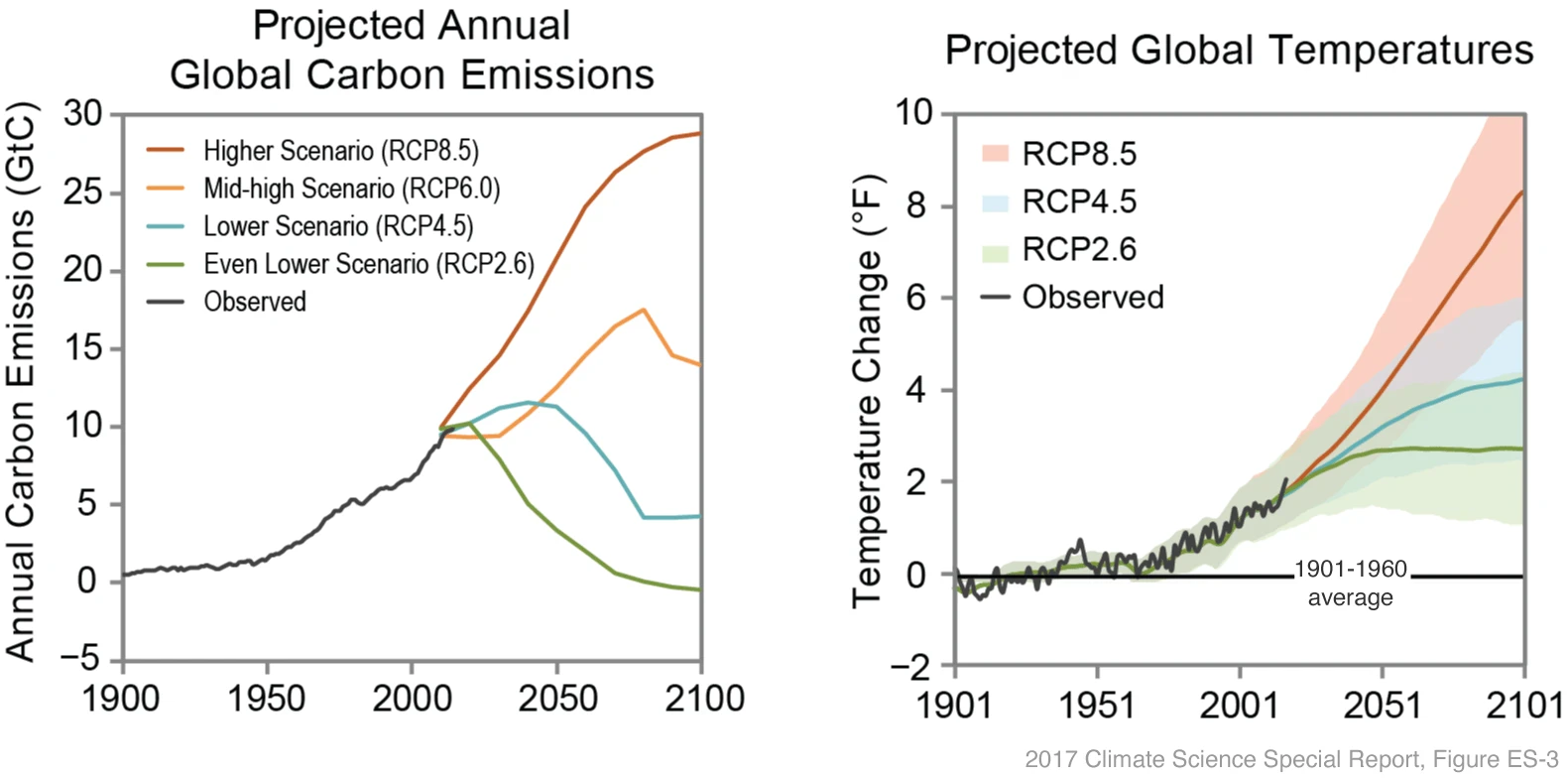
(left) Hypothetical pathways of carbon emissions ("representative concentration pathways," or RCPs) throughout the twenty-first century based on different possible energy policies and economic growth patterns. (right) Projected temperature increase relative to the 1901-1960 average depending on which RCP we eventually follow. Image by Katharine Hayhoe, from the 2017 Climate Science Special Report by the U.S. Global Change Research Program.
RCP 2.6 Model (Best-case scenario)
Governments and businesses worldwide collaborate intensively to reduce greenhouse gas emissions, aiming to limit global temperature rise to no more than 1.5-2.0 degrees Celsius. In this regard, the Company has formulated financial plans addressing risks and opportunities associated with climate change covering operating expenses (OPEX), capital expenditures (CAPEX), and debt as follows:
| Impacts on the transition to a low-carbon economy: | Opportunities: |
|---|---|
|
Physical risks will decrease, but the Company will face transition risks to meet evolving customer demands and stricter government regulations. The Company anticipates increased investment to ensure business sustainability and compliance with more stringent standards, Adaptation & Mitigation as follows:
|
The Company has opportunities to gain competitive advantages through
|
RCP 4.5 Model (Moderate scenario)
Under the RCP 4.5 scenario, which represents moderate greenhouse gas reduction policies, the global average temperature is projected to increase by approximately 2.0 to 3.0 degrees Celsius by 2100 (B.E. 2643). This level exceeds the Paris Agreement's goal of limiting temperature rise to no more than 2 degrees Celsius. This scenario will lead to more severe and frequent weather variability, as well as an anticipated average sea level rise of approximately 0.35 to 0.70 meters, directly impacting ecosystems and the adaptive capacity of living organisms.
The Company has adopted Scenario Analysis, following the RCP 4.5 approaches, to assess Physical Risks in each geographical area. This assessment references data from Thailand's climate change projections, as outlined in the National Adaptation Plan (NAP) dated April 2024, with key details as follows:
Settlement and Human Security Risks: The Company focuses on assessing areas highly vulnerable to heat, floods, and droughts by analyzing data from Thailand's risk map for the period 2016 - 2035 (B.E. 2559 - 2578). This information is integrated into project site selection, climate-resilient architectural design, and engineering system planning to enhance the long-term resilience of residential projects.
Historically, human settlements have been determined by geographical advantages and favorable climates. However, current global warming is transforming these factors into new, more complex, and severe challenges. Climate change risk is therefore not merely an environmental issue but a critical variable for the stability of settlements and the long-term value of real estate.
The Company recognizes the urgent need to elevate decision-making criteria from traditional residential development planning to Climate-Informed Development Planning. This aims to ensure the safety and well-being of residents, based on national climate model analysis under the RCP 4.5 scenario by the Office of Natural Resources and Environmental Policy and Planning (ONEP), which identifies strategic areas vulnerable to heat stress, drought, and floods, particularly in the 10 provinces with the highest risk index, as detailed in the accompanying risk map.
Table showing provinces with high climate change risk Top 10
Human Settlement and Security Sector, during 2016 - 2035 (B.E. 2559 - 2578)
| Risk | Risk Area | |
|---|---|---|
| Heat Stress | RCP 4.5 | Bangkok, Nakhon Ratchasima, Samut Prakan, Buriram, Chonburi, Ubon Ratchathani, Songkhla, Nonthaburi, Surin, Phuket |
| RCP 8.5 | Bangkok, Nakhon Ratchasima, Samut Prakan, Buriram, Chonburi, Ubon Ratchathani, Songkhla, Surin, Phuket, Nonthaburi | |
| Drought | RCP 4.5 | Bangkok, Nakhon Ratchasima, Khon Kaen, Samut Prakan, Ubon Ratchathani, Roi Et, Buriram, Surin, Chaiyaphum, Udon Thani |
| RCP 8.5 | Bangkok, Nakhon Ratchasima, Khon Kaen, Roi Et, Samut Prakan, Ubon Ratchathani, Udon Thani, Buriram, Maha Sarakham, Surin | |
| Floods | RCP 4.5 | Bangkok, Nakhon Ratchasima, Chiang Mai, Nakhon Si Thammarat, Chiang Rai, Nakhon Sawan, Kamphaeng Phet, Phitsanulok, Khon Kaen, Phra Nakhon Si Ayutthaya |
| RCP 8.5 | Bangkok, Nakhon Ratchasima, Khon Kaen, Nakhon Si Thammarat, Chiang Mai, Samut Prakan, Phra Nakhon Si Ayutthaya, Kamphaeng Phet, Songkhla, Nakhon Sawan | |
Image showing the risk map for human settlement and security sector Under the scenario RCP 4.5, focusing on areas at risk from heat, floods, and droughts. shown on the map for the period B.E. 2016 – 2035, with darker shades indicating areas expected to be highly impacted.
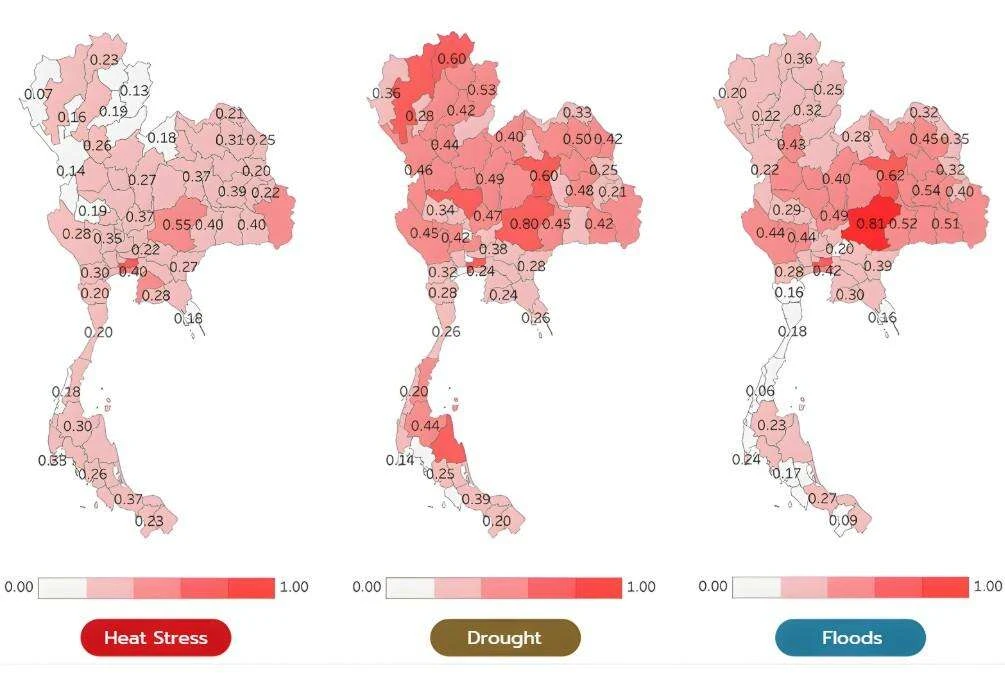
Source: Office of Natural Resources and Environmental Policy and Planning (2021)
Table showing project development risk areas due to climate change
| Region | Physical Risk | Transition Risk | |||||||||
|---|---|---|---|---|---|---|---|---|---|---|---|
| Floods | Severe Storms | Land Quake | Waves Heat | PM 2.5 Dust | Shortage Water / Drought | Rising sea levels / Saltwater intrusion | Policy | Technology | Market | Reputation | |
| BKK / Perimeter | VH | M | M | M | H | M | H | H | L | H | M |
| Medium | VH | M | L | M | L | L | H | H | L | H | M |
Strategies to reduce emissions and enhance greenhouse gas absorption
Climate-related risk management procedures:
| Strategy | Scope | Operational Guidelines | ||
|---|---|---|---|---|
| 1 | 2 | 3 | ||
| Increase the proportion of renewable energy use. |  |
|
Increase the installation of solar energy systems, such as Solar Rooftop / Solar Carport, to generate electricity for self-consumption within buildings or sales office projects. | |
| Increase electrical energy efficiency in project design and development processes. | |
Design energy-efficient buildings, reduce energy loss, inspect and improve systems to enhance electrical energy efficiency. | ||
| Efficient resource and waste management | |
Efficient resource utilization, waste reduction at the source, promotion of recycling and resource circulation, and effective waste management, reducing landfill disposal. | ||
| Promote supply chain collaboration | |
Participate as a member and support partners in reducing greenhouse gas emissions throughout the supply chain, from upstream to downstream activities. | ||
| Restore and conserve natural resources | |
Restore forest integrity by supporting tree planting in areas to serve as carbon sinks. | ||
| Emissions Trading Scheme (ETS) | |
|
|
The Company does not currently participate in emissions trading schemes. However, the Company is monitoring developments in carbon markets, including Thailand's voluntary carbon market (T-VER), and will evaluate the potential use of high-quality carbon credits to complement its greenhouse gas reduction strategy after maximizing direct emission reduction measures. |
Performance Results
Greenhouse Gas Management
The company has applied climate change-related risks and opportunities in its business operations. and emphasizes addressing climate change by adopting energy-efficient and environmentally friendly home and building design concepts from the planning and development stages. Homes and condominiums are designed to be consistent with and adaptable to climate change, reducing long-term energy consumption and greenhouse gas emissions throughout the product lifecycle. The design approaches focuses on sustainable energy efficiency.
House Design and Project Layout
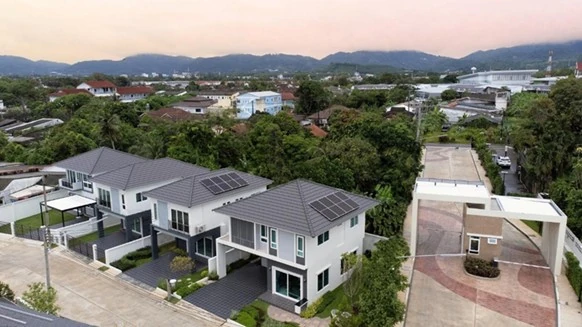
- Design layout and wind direction to receive appropriate natural light and ventilation.
- Design main living areas such as bedrooms, reception rooms, and living rooms to receive sufficient natural light, with a glass area to room area ratio of not less than 15%, which helps reduce electricity consumption for lighting during the day.
- Design by specifying and selecting products that reduce greenhouse gas emissions, such as lightweight brick materials and house wall paints that help reduce heat accumulation, making homes cooler and reducing electricity consumption.
- Design incorporating innovation for energy saving, such as Motion Sensors or smart control systems, capable of setting on/off times to reduce electricity consumption.
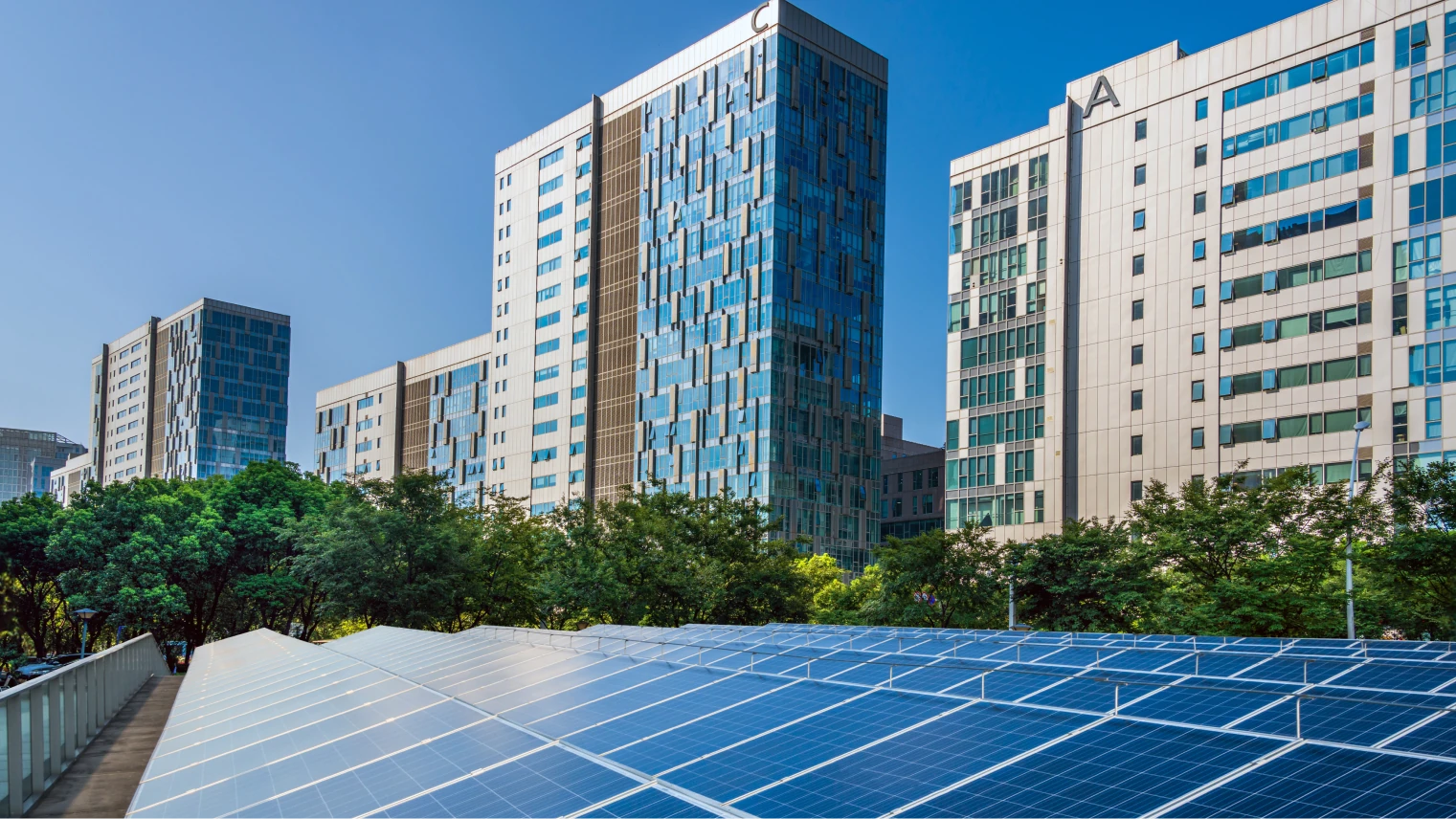
- Design and install Solar Roof using renewable energy to manage energy in sales offices, construction offices, show homes, ready-to-sell homes, and temporary customer parking.
Building Design and Selection of Energy-Saving Materials for High-Rise Projects
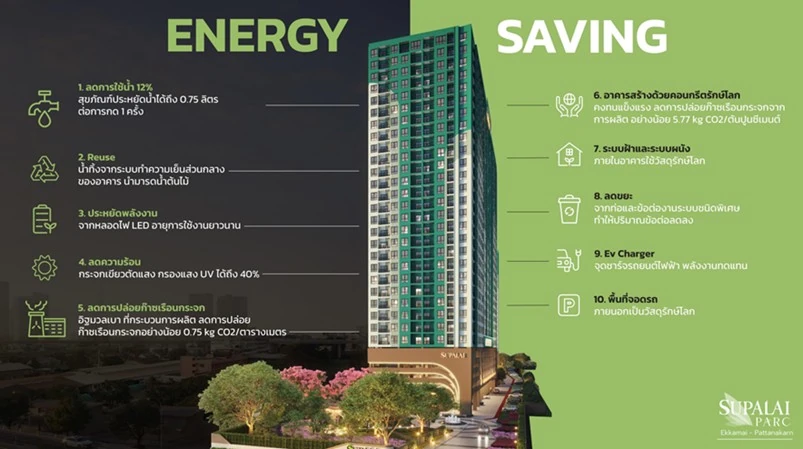
- Project design by orienting buildings north-south, considering wind direction, and designing balconies to shade the building from direct sunlight, resulting in cooler buildings and reduced energy consumption.
- Layout of buildings to avoid the west direction and design of opening sizes (Window-to-Wall Ratio) to be consistent with actual use, to receive natural light and ventilation.
-
Design by selecting energy-saving technologies and equipment.
- Selection of low-carbon materials: choosing construction materials with environmentally friendly production processes to reduce embodied carbon in the construction process, such as using fiberglass insulation, which is Green Label certified, meaning its raw materials and production process have minimal environmental impact and are safe. Installed above the second-floor ceiling, it reduces heat from the attic area, addressing rising climate change.
- Selection of building paints with heat and light reflective properties to reduce heat absorption in walls, combined with the use of high thermal insulation materials such as lightweight bricks and fiberglass insulation (Green Label) installed above the ceiling, along with vinyl soffit with heat vents, to reduce heat accumulation under the roof.
- Environmentally friendly materials such as Inverter air conditioners, energy-saving label No. 5.
- Utilizing innovative hydro-powered faucets that generate electricity from water pressure to reduce reliance on grid electricity.
- Solar cell post-top lights use 100% solar energy, reducing electricity consumption. As they are outdoor post-top lights, they must use UV-resistant and weather-resistant materials with a long lifespan, which helps reduce the frequency of material replacement and long-term waste.
- Energy-saving glass No. 5, where the gap between the glass acts as a highly efficient insulator, reducing heat transfer from outside to inside, helping to reduce electricity consumption.
House and Building Design to Cope with Climate Change
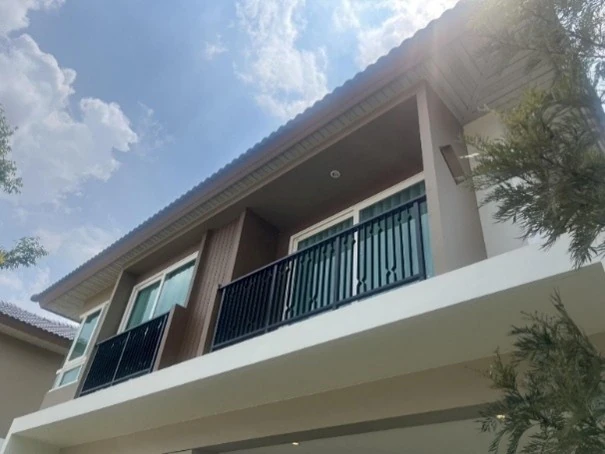
The company develops house and building designs to cope with climate change, enabling structures to withstand and function continuously under severe and erratic climate change impacts such as rising heatwaves, floods, severe storms, droughts, and helping to reduce building greenhouse gas emissions.
- Structural design to reduce the risk of damage to buildings from natural disasters, such as designing structures to withstand earthquake forces in high-risk areas and designing to accommodate ground subsidence.
- Designing long eaves to provide sun or rain protection helps the building adapt well to heatwaves, reducing residents' reliance on excessive electricity. It also serves as a design to cope with erratic rainfall, protecting walls, window frames, and balconies from heavy and severe rain.
The company recognizes that the real estate business plays a crucial role in contributing to the reduction of global greenhouse gas emissions. Therefore, it has established operational guidelines to address climate change, elevating climate change management as one of the core pillars of its sustainable business strategy. The adaptation processes to climate change are as follows:
Reduction of direct and indirect greenhouse gas emissions from energy consumption
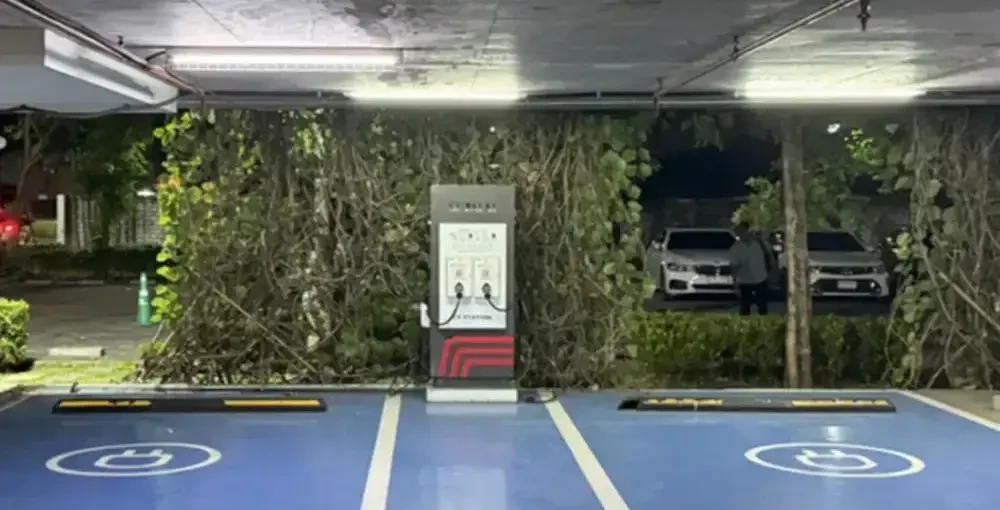
1.1 Transition to clean energy vehicles
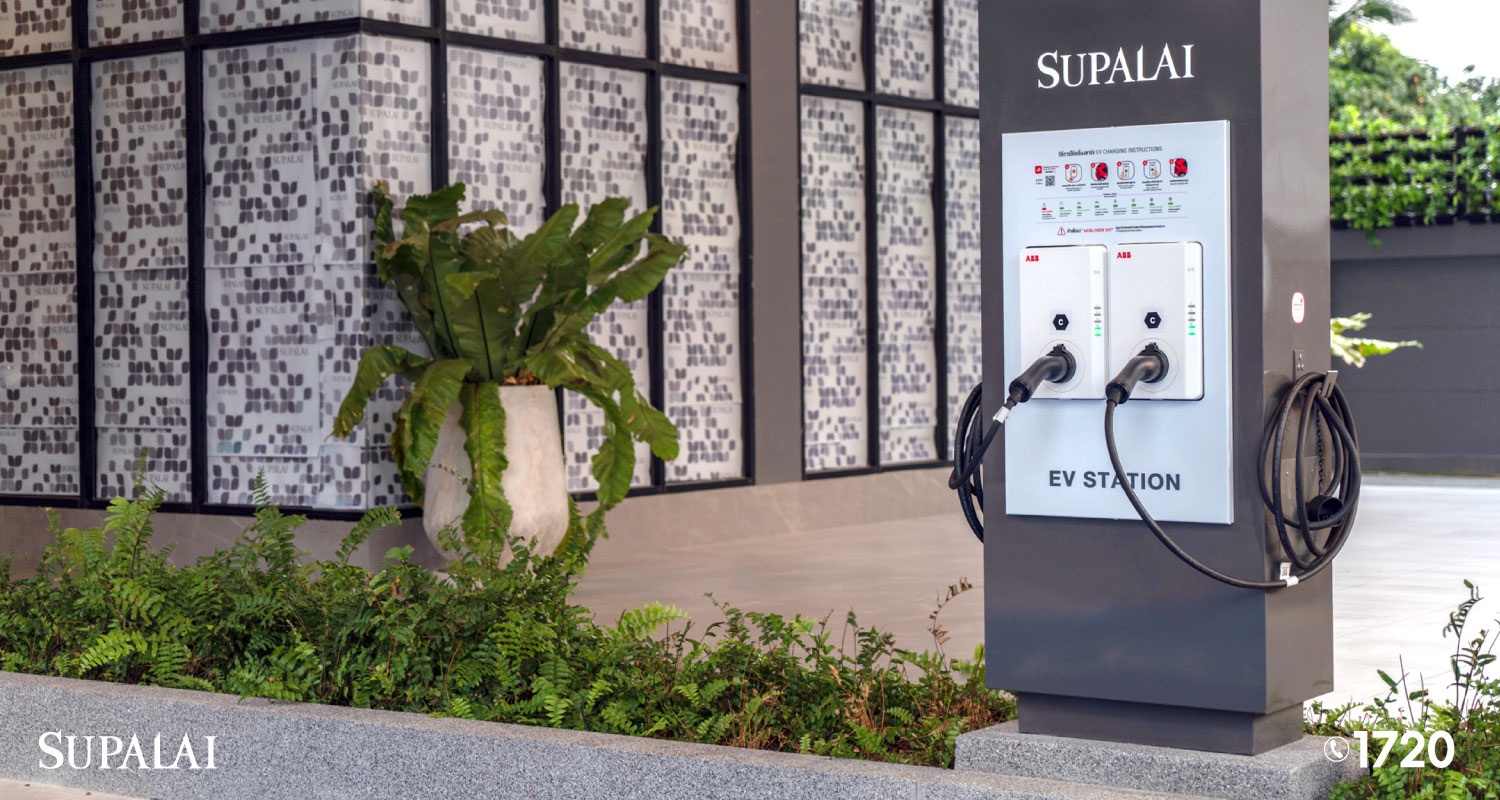
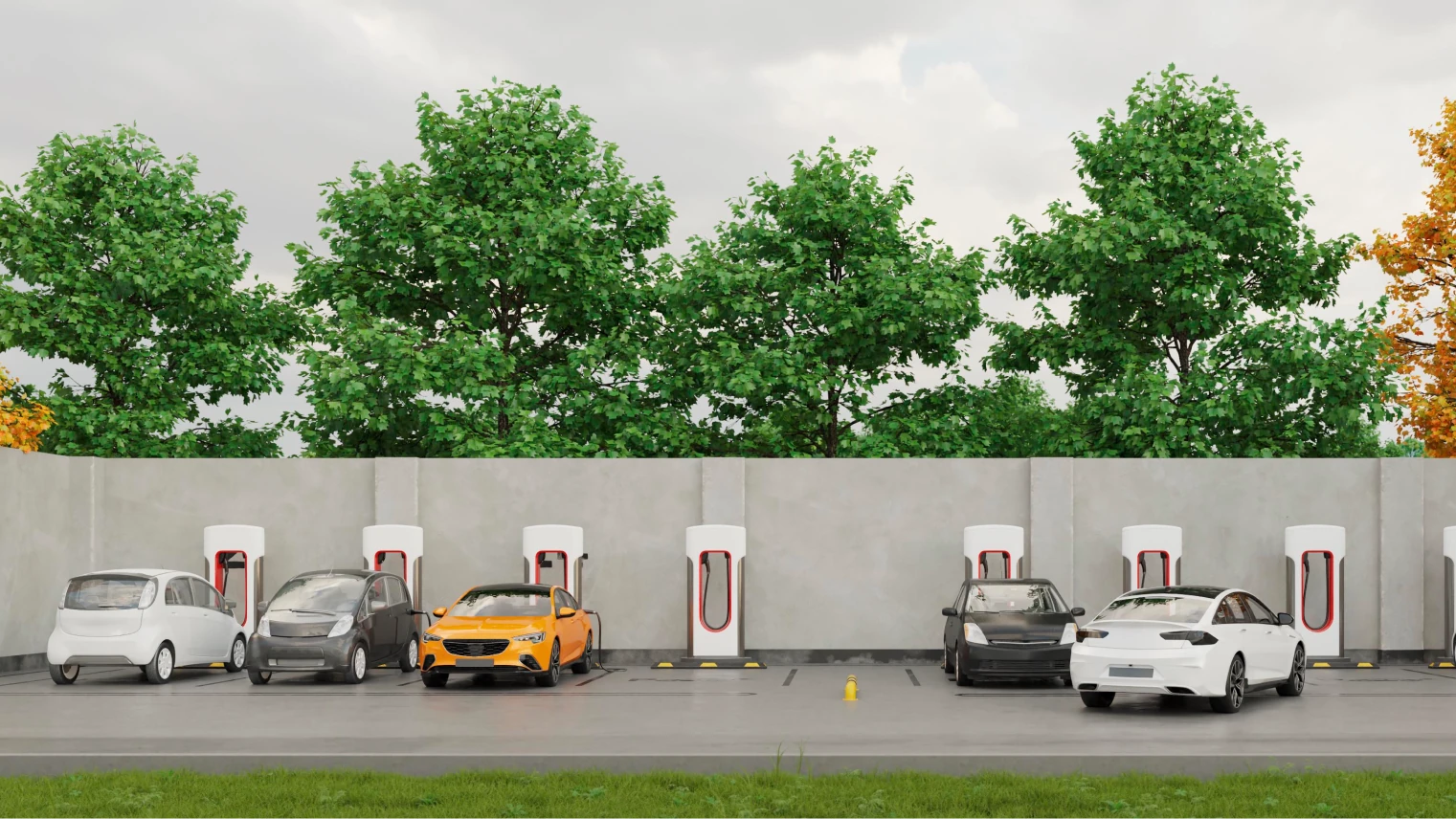
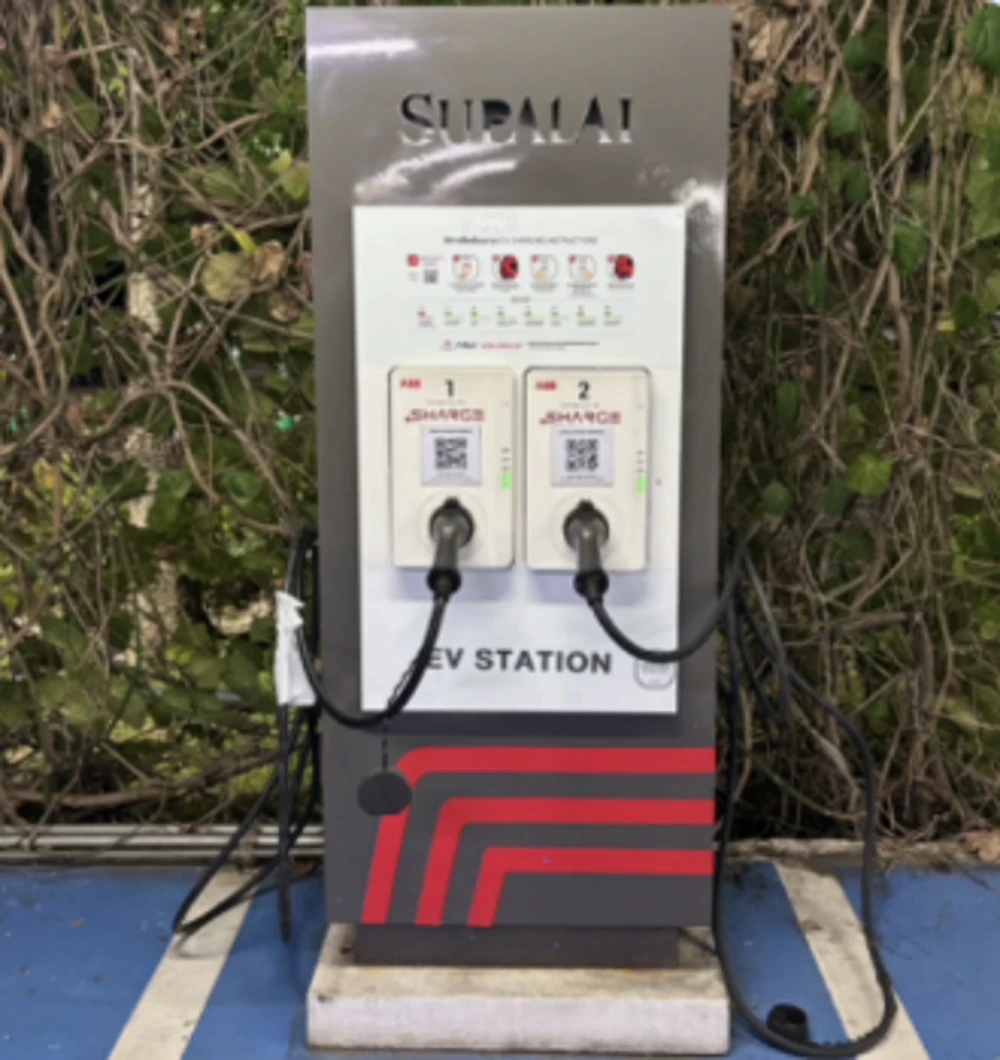
The company has a policy to procure 100% Battery Electric Vehicles (BEV), which have zero tailpipe emissions during operation, and Hybrid Electric Vehicles (HEV), which significantly improve fuel efficiency and reduce carbon dioxide emissions compared to conventional fuel vehicles. This transition to clean energy vehicles reflects efficient resource management in line with Environmental, Social, and Governance (ESG) frameworks, aiming to reduce the organization's carbon footprint across the entire operational chain, from central operations to project level. In 2025, the company allocated a total of 15 alternative energy vehicles into its operational system, divided into: 4 electric vehicles and 4 hybrid vehicles for head office, and 3 electric vehicles and 4 hybrid vehicles for project operations. This resulted in a reduction of 91.33 tCO2eq greenhouse gases and a reduction in fuel energy costs of 49,000 baht.
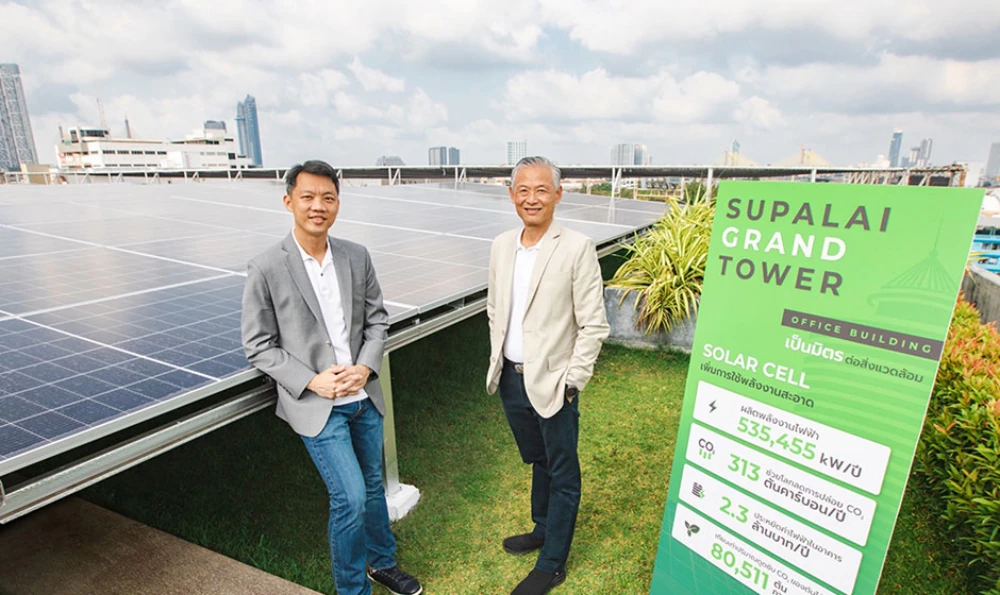
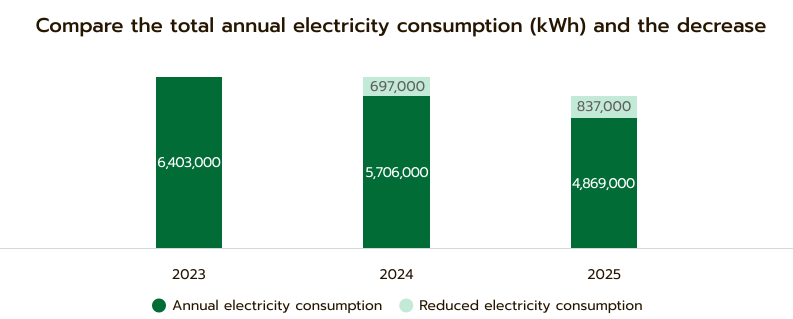
1.2 Energy Management of Supalai Grand Tower Building to reduce greenhouse gas emissions. In 2025, electricity consumption was reduced by 873,000 kWh/sq.m. and percent reduction in greenhouse gas emissions 436.5 tCO2eq from the following operations:
- Install Lift Regenerative Drive System, an energy-saving technology that converts kinetic energy from elevator movement during braking e.g., descending with a heavy load or ascending with a light load into electrical energy, which is then fed back into the building's power supply system instead of being dissipated as heat, saving approximately 20-75% of energy. When the elevator moves down with a heavy load or up with a light load (light car weight than counterweights) the motor acts as a generator The inverter or Regenerative Drive unit receives the generated alternating current, converts it to direct current (DC), and then converts it back to stable alternating current to feed back into the building's electrical system.
- Improve the Chiller system by installing Chiller Plant System Management (CPMS) equipment, which is a system used to control and manage the cooling system to monitor the real-time status of various equipment such as temperature, pumps, cooling towers, and Chiller operation, controlling the on-off of equipment to suit the usage load for analysis and improvement of operation to minimize energy consumption, which can help reduce energy costs.
- Replace LED lights in common corridors and adjust the lighting system to operate from 10:00 PM to 6:00 AM to help reduce electricity consumption by 1,191,035 units.
| Year | Electricity consumption (kWh) | Electricity consumption (MWh) |
|---|---|---|
| 2023 | 6,403,000 | 6,403 |
| 2024 | 5,706,000 | 5,706 |
| 2025 | 4,869,000 | 4,869 |
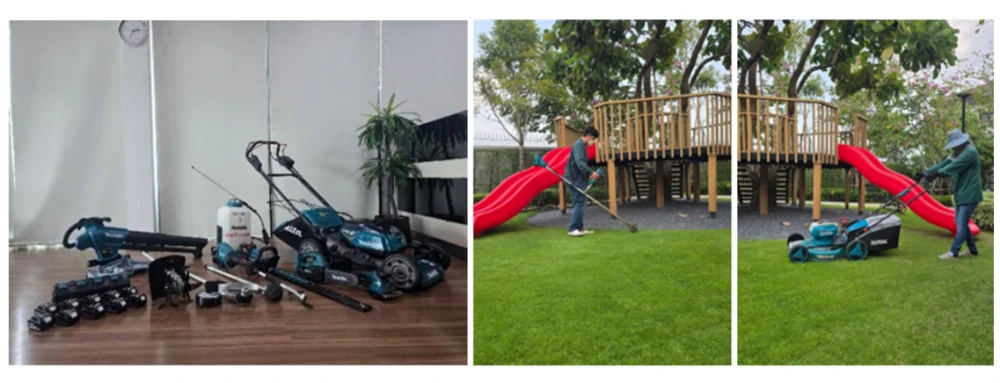
1.3 Convert gardening equipment and tools to those using alternative and renewable energy. By using solar energy through the Solar Cell system installed in the project, reducing reliance on fossil fuels from traditional energy sources, reducing pollution, and long-term environmental impact.
| Year | Fuel consumption for gardening tools (liters) |
|---|---|
| 2024 | 16,117.208 |
| 2025 | 14,054.61 |
1.4 Campaign activities and cooperation with employees to save electricity in the office.
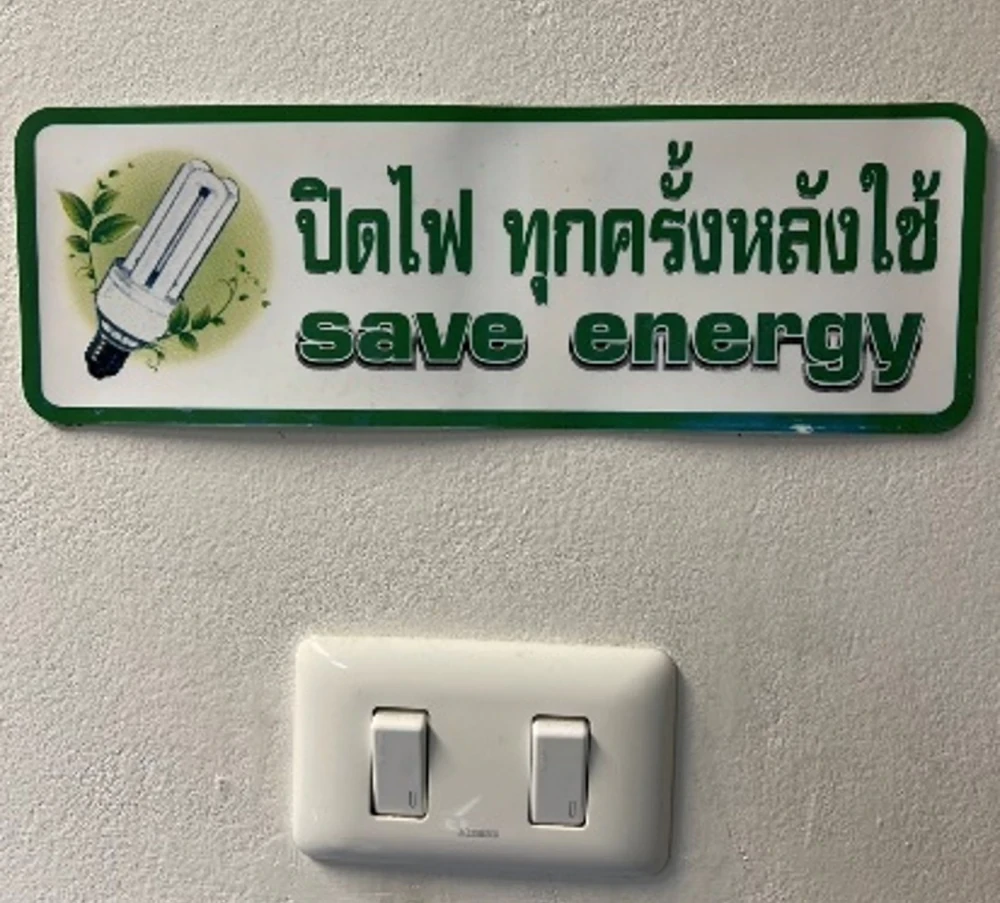
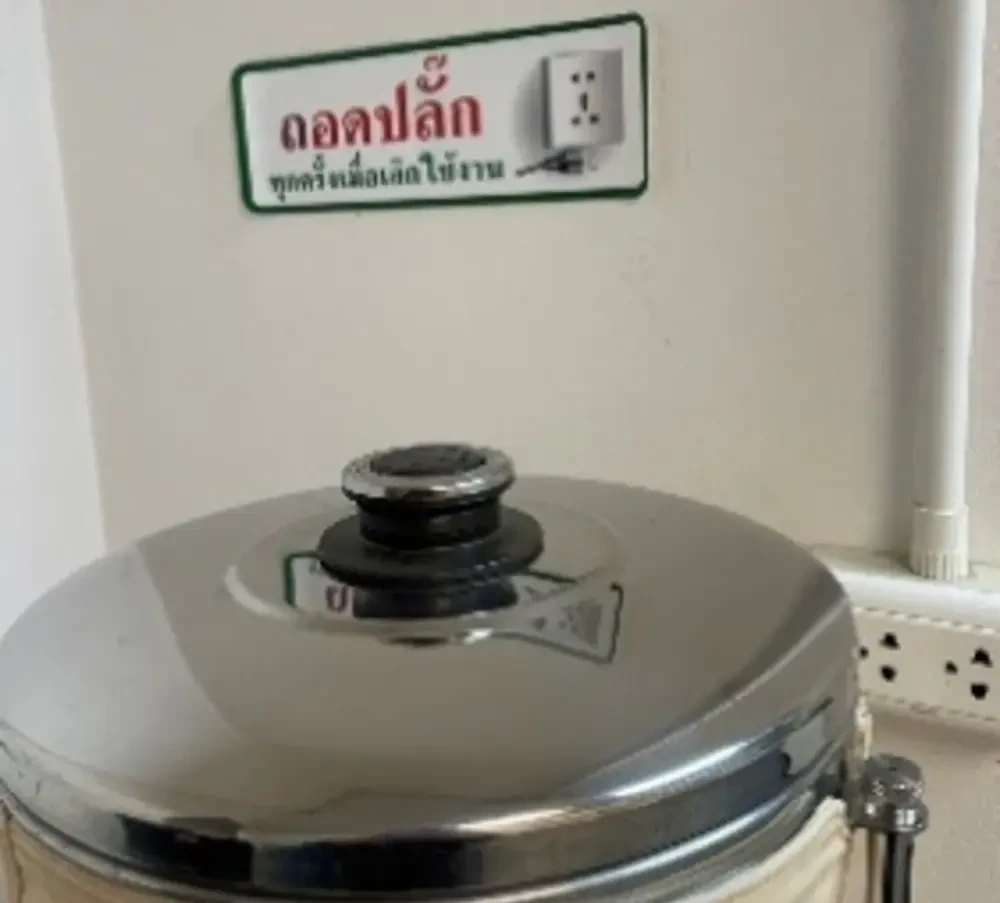
- Campaign to turn off lights and electrical appliances when not in use: encourage employees to turn off lights, computers, photocopiers, and office equipment every time after use or before leaving meeting rooms.
- Adjust air conditioner temperature appropriately: set office air conditioner temperature to an appropriate level, such as 25–26 degrees Celsius, and communicate to employees the impact on energy reduction.
- Maximize natural light by encouraging opening curtains or arranging workspaces to receive natural light during the day, to reduce electricity consumption for lighting.
- Communicate and post energy-saving warning signs, stickers, or campaign posters near light switches, elevators, and electrical appliances to encourage daily employee participation.
1.5 Internal carbon offset activities
- Reduce greenhouse gases, support waste separation, and produce 97,400 employee uniforms from recycled plastic, reducing carbon by 9.74 tCO2eq and reduce energy from ironing/year, which helps reduce carbon by 25.27 tCO2eq Total carbon reduced 35.01 tCO2eq equivalent which is equivalent to planting 3,640 trees.
- Transforming leftover lightweight brick scraps into "fragrant stones" generates supplementary income for local communities (Amphan Community Enterprise, Mae Sot District, Tak Province) and reduces carbon dioxide emissions equivalent to 0.002 kgCO2eq /piece

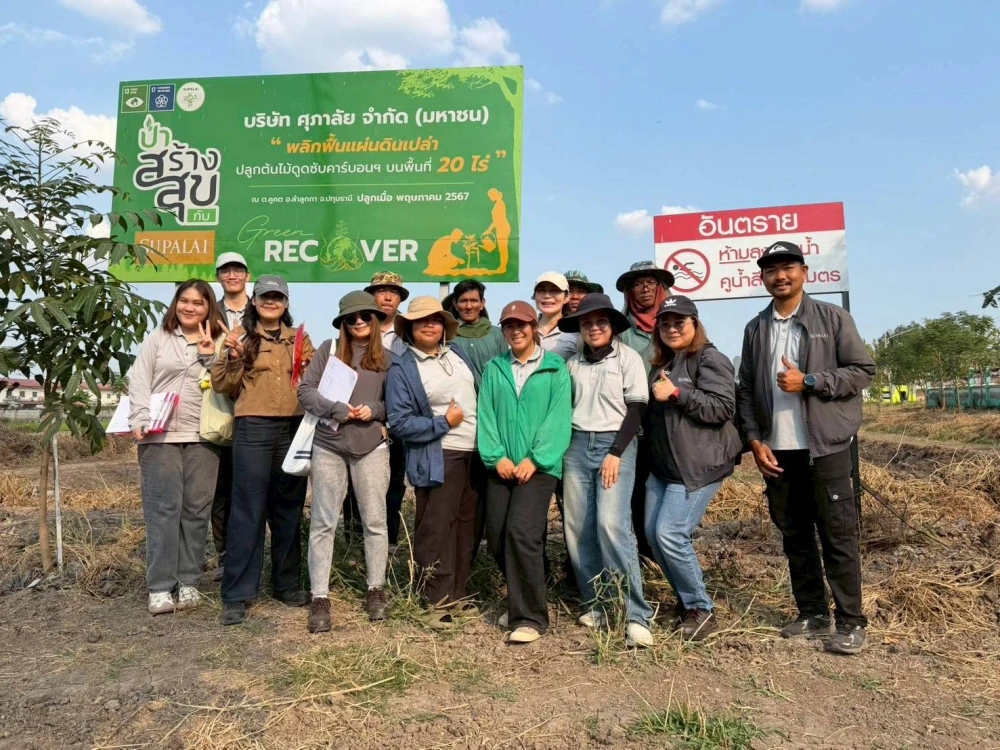
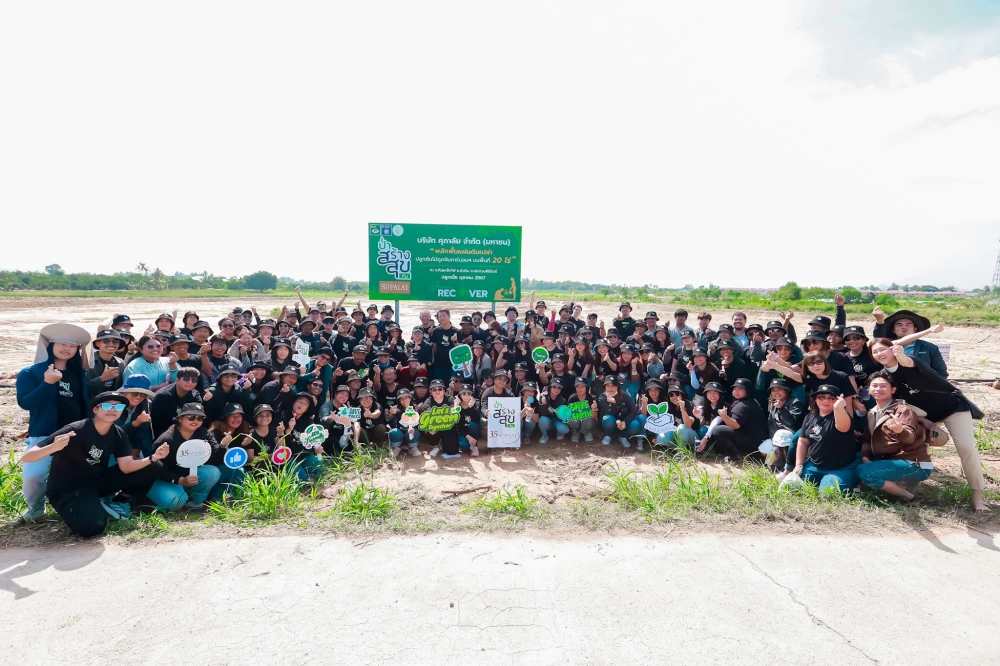
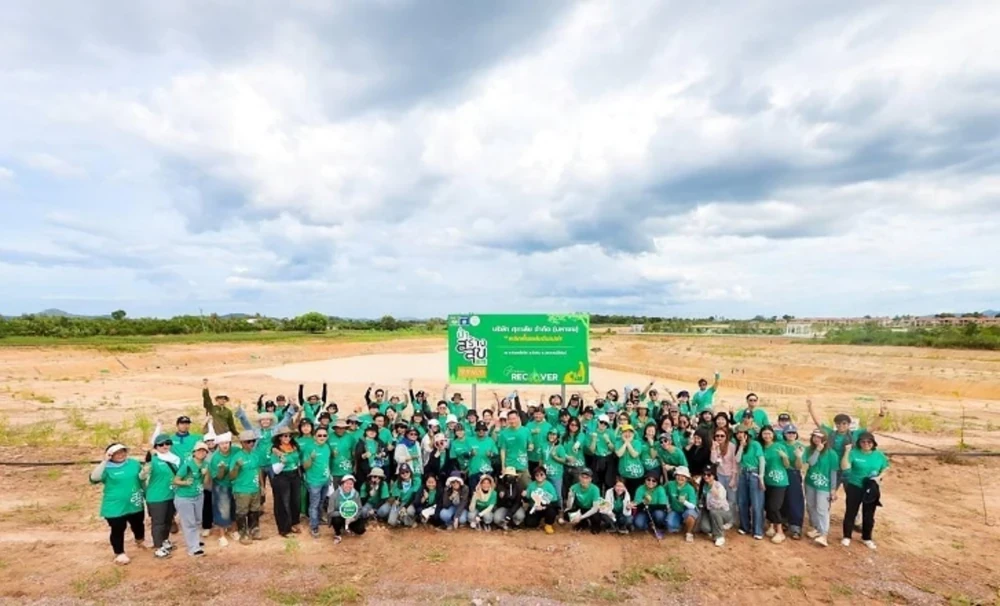
- Forest planting and ecosystem restoration project: "Forest for Happiness" activity for the 3rd consecutive year, where Supalai employees jointly planted 6,650 trees on company land, totaling 55 rai (approximately 8.8 hectares). This is expected to reduce greenhouse gas emissions by 665 tCO2eq within 10 years. This year's project focuses on planting Thai economic tree species that provide shade and long-term benefits, including Yang Na, Payung, Phayom, and Mahogany, all of which are fast-growing trees with efficient carbon dioxide absorption potential.
The company focuses on building awareness and engagement among employees at all levels in climate change management and greenhouse gas reduction. Therefore, it organizes various internal and external activities and projects to enhance the necessary knowledge and skills for operations to respond to climate change risks, as follows:
1. Fostering a culture of energy saving and climate change awareness among employees.
- Encourage employees to use company pool cars to reduce carbon and costs, promoting fuel energy saving, and requiring all hybrid pool cars to use E20 fuel to help reduce carbon dioxide emissions and the organization's operational carbon footprint.
- Promoting environmental knowledge by publicizing and recommending online training courses to employees.
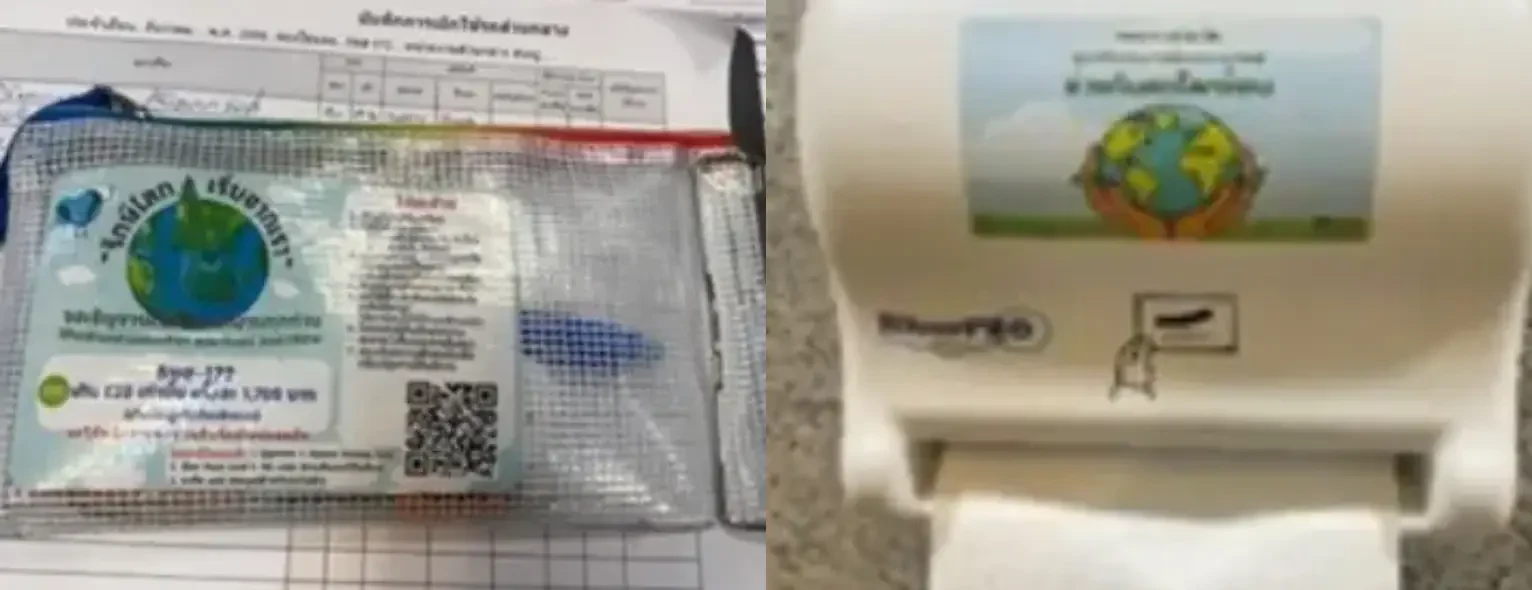
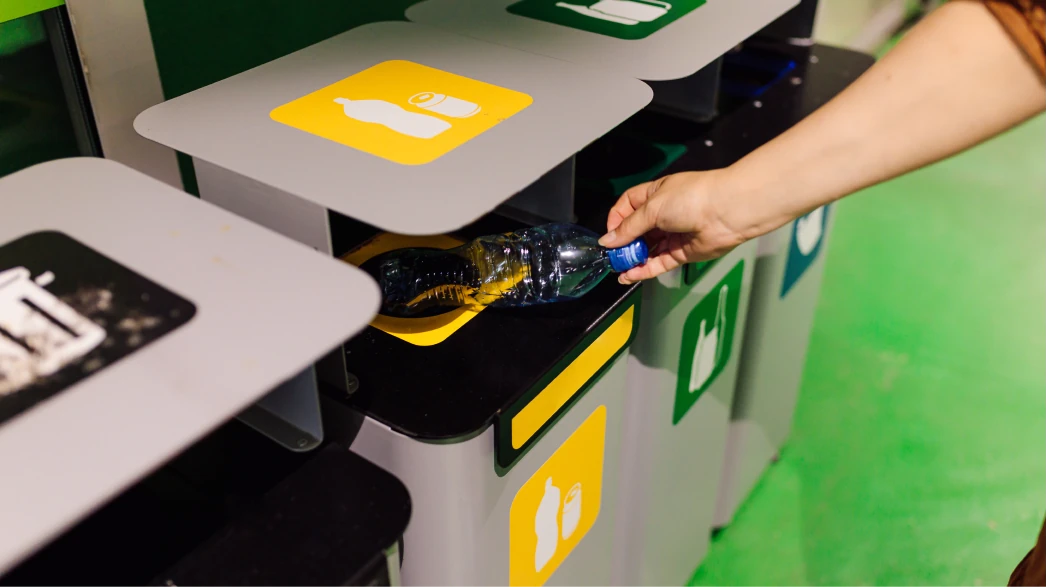
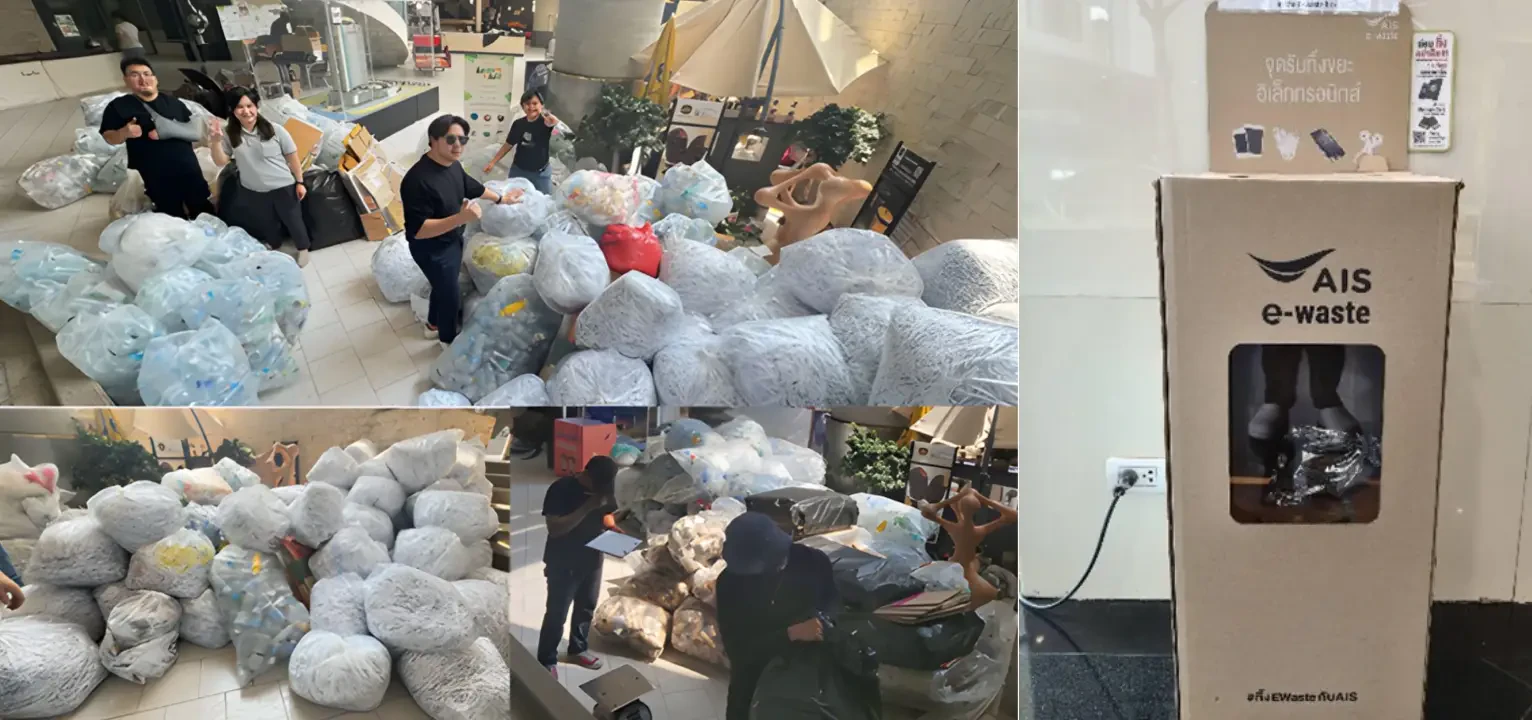
- Employee participation in activities to promote climate change mitigation. Encourage employees to separate waste for the "More Separation, More Gain" project in collaboration with Recycle Day in 2025, reducing greenhouse gases by 11.82 tCO2eq , equivalent to planting 1,228 large trees.
- E-Waste project with AIS: total waste of 20 kilograms, equivalent to a carbon footprint reduction of 0.123 tCO2eq, which is equivalent to planting 14 trees.
- Implement waste separation systems in the office, especially for waste from design and documentation, to be recycled according to circular economy principles.
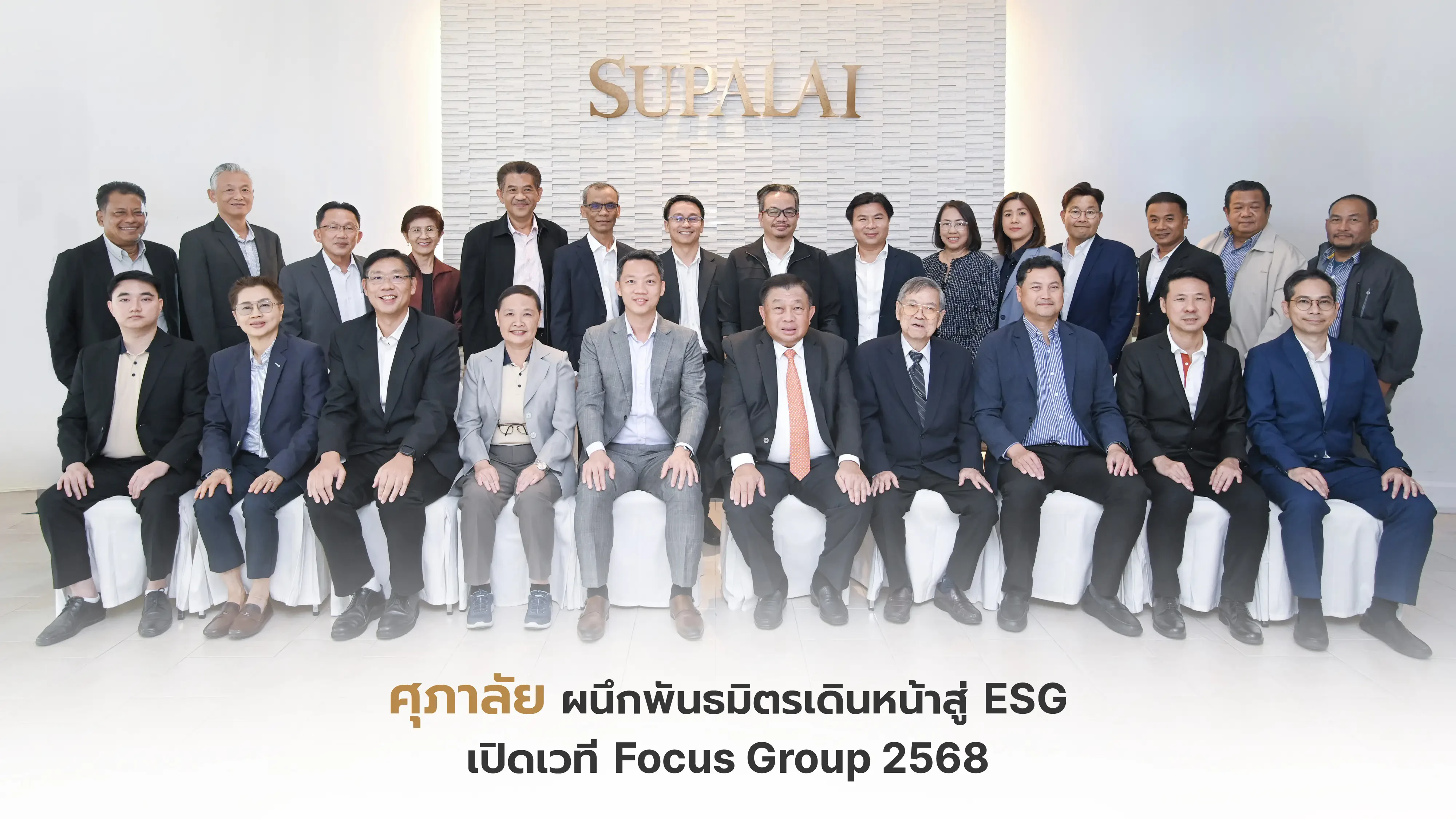
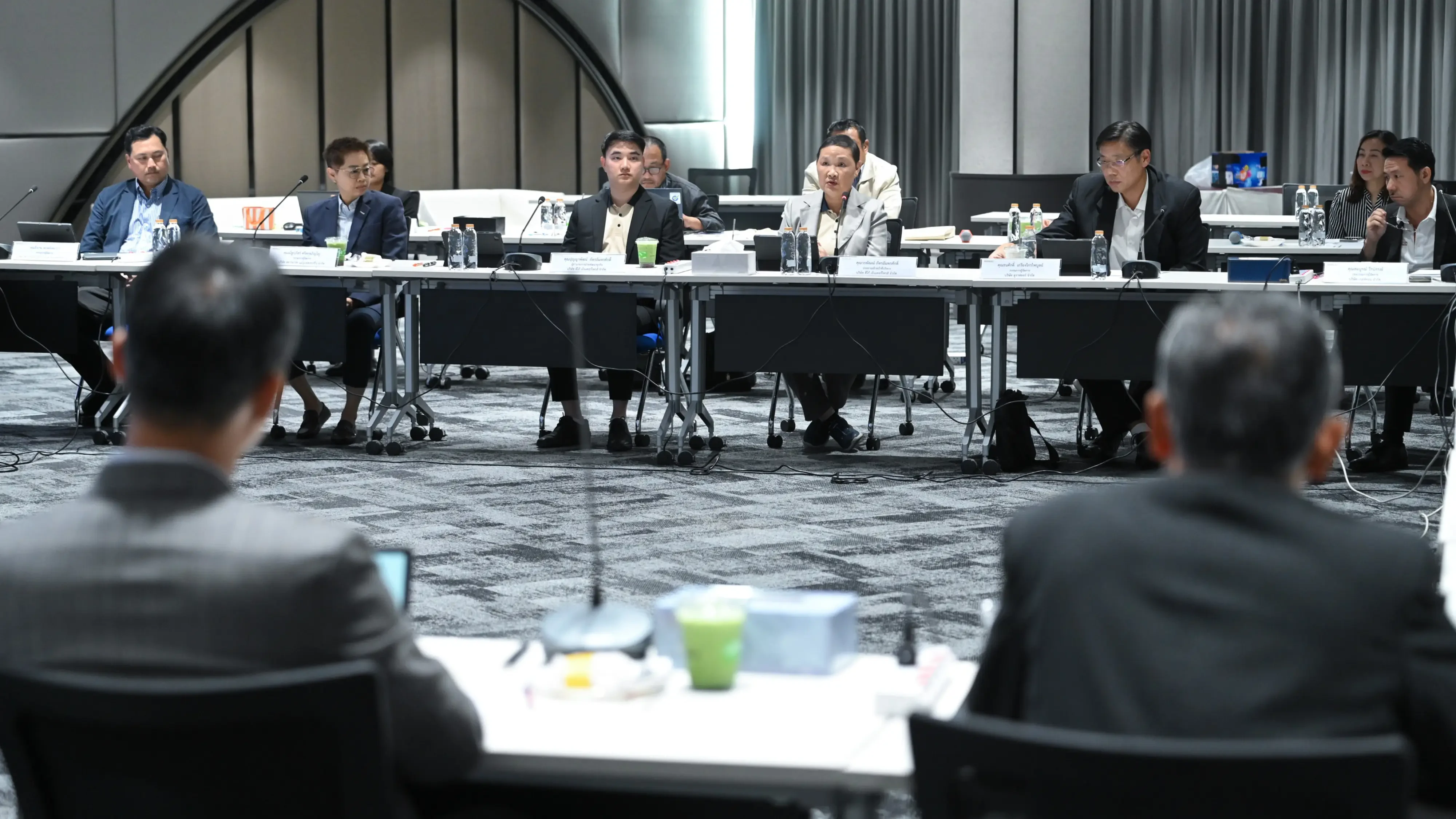
1. Organize ESG Focus Group forums with business partners and allies annually for the 7th consecutive year. with discussions on climate change impacts and environmentally friendly procurement guidelines.
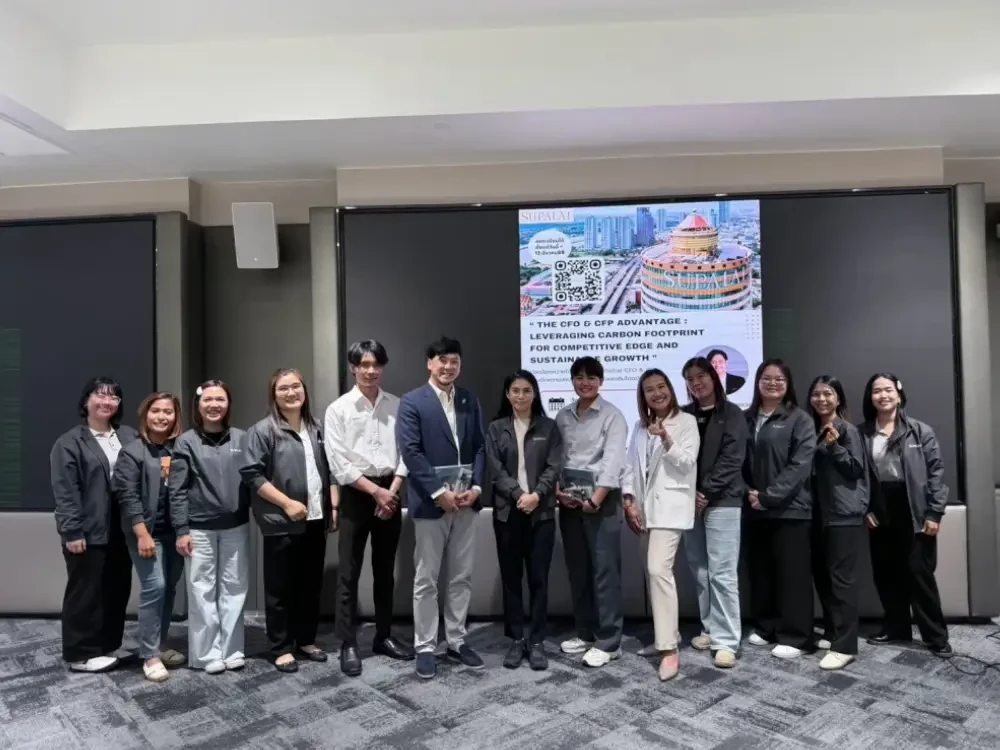
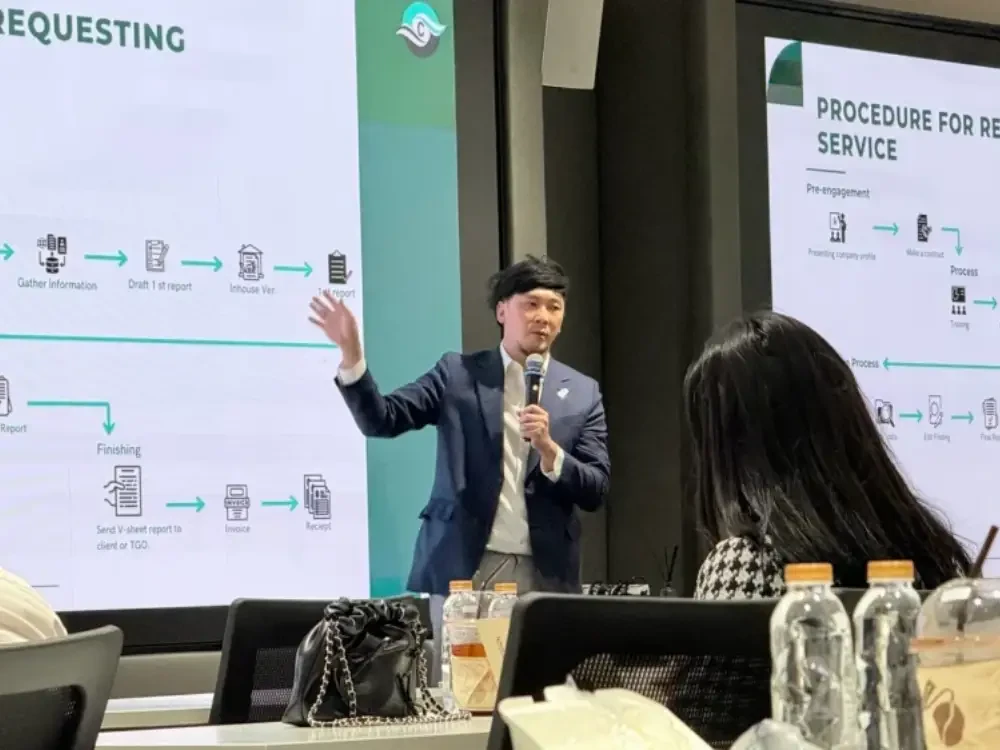
2. Organize training on the topic of " The CFO & CFP Advantage: Leveraging Carbon Footprint for Competitive Edge and Sustainable Growth” Support partners in registering for CFO (Carbon Footprint of Organization) and CFP (Carbon Footprint of Products), which will lead to the establishment of effective management guidelines for reducing greenhouse gas emissions at factory, industry, and global levels, and enhance partners' potential and capabilities to jointly build a sustainable supply chain management in line with the organization's sustainable development goals, while considering social and environmental responsibilities. with participating partners. Quantity 105 Supplier
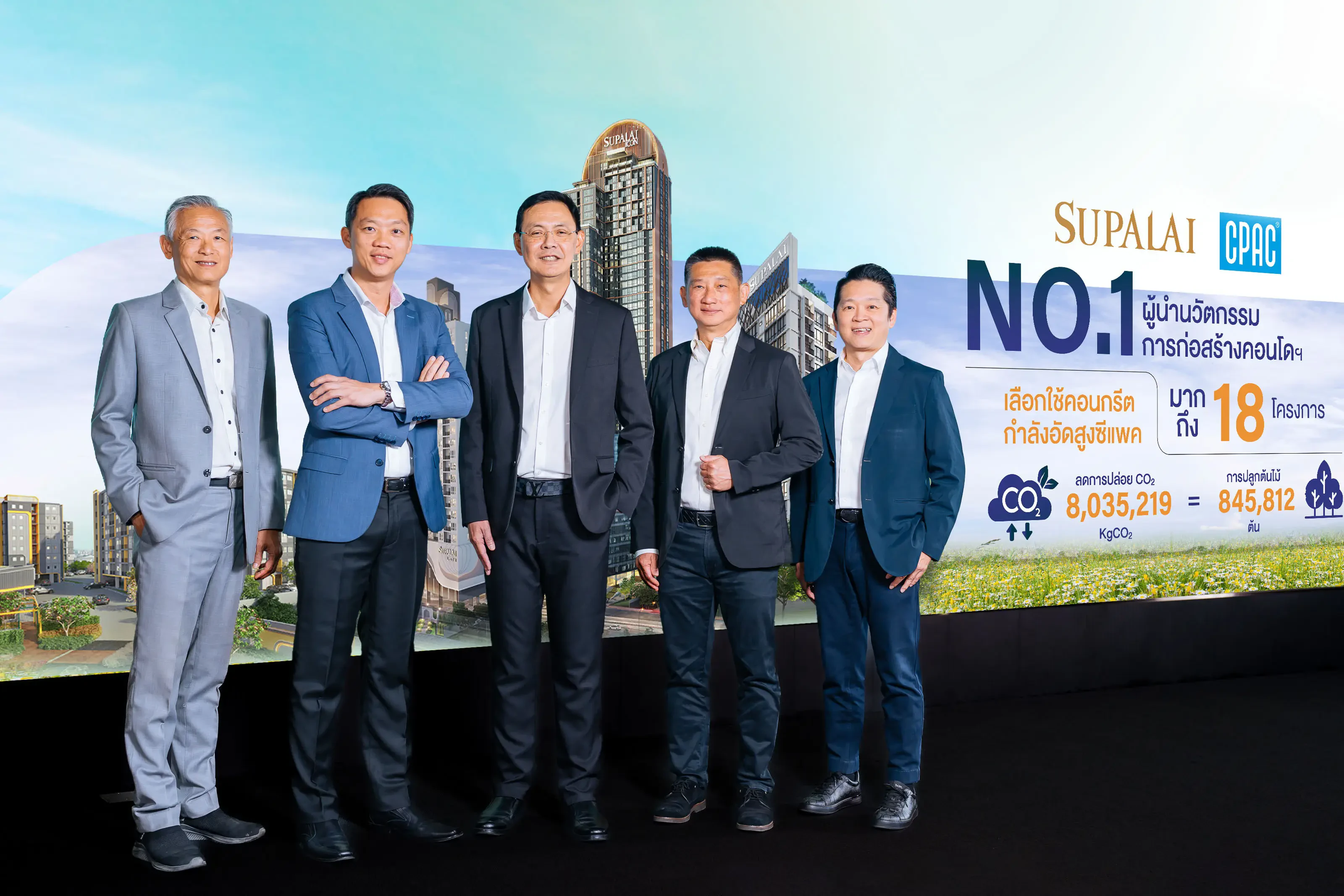
3. Collaborate with CPAC business partners in the cement business, Siam Cement Group or SCG Initiating innovation in residential project development, focusing on mutual knowledge and experience exchange to study and present high-quality, environmentally friendly products that can be practically applied in the construction industry. This includes using CPAC High Strength Concrete for the construction of 18 Supalai condominium projects, which reduces climate impact by reducing greenhouse gas emissions by 8,035.32 tCO2eq, or the equivalent of planting 845,812 trees.

Membership in Thailand Carbon Neutral Network (TCNN)
The company is a member in the Thailand Carbon Neutral Network (TCNN) Under the operation of the Thailand Greenhouse Gas Management Organization (Public Organization), as 1 of 854 pioneering organizations in greenhouse gas management, to demonstrate its intention and commitment to managing and reducing greenhouse gas emissions. Participation in this network promotes the exchange of knowledge, best practices, and carbon-neutral operational guidelines with public and private sector agencies, as well as supporting the organization in developing effective approaches to reduce and offset greenhouse gas emissions, in line with climate change mitigation goals and sustainable development. The company has joined the Thailand Carbon Neutral Network of the Thailand Greenhouse Gas Management Organization (Public Organization) or TGO.
Organizational Greenhouse Gas Emission Data
The company prepares its organizational carbon footprint (Carbon Footprint for Organization: CFO) data once a year, referencing the calculation methodology based on the guidelines for organizational carbon footprint assessment by the Thailand Greenhouse Gas Management Organization (Public Organization), with the reporting scope covering only Supalai Public Company Limited, specifically Supalai Grand Tower, Low- rise, High-rise areas, totaling 233 projects.
In 2025, the company's organizational carbon footprint was registered, with data from January 1 to December 31, 2025. Thailand Greenhouse Gas Management Organization (Public Organization)
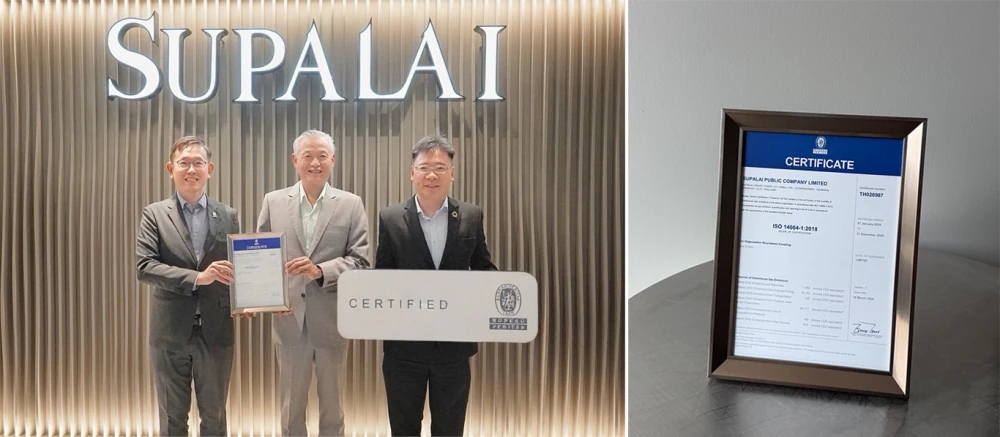
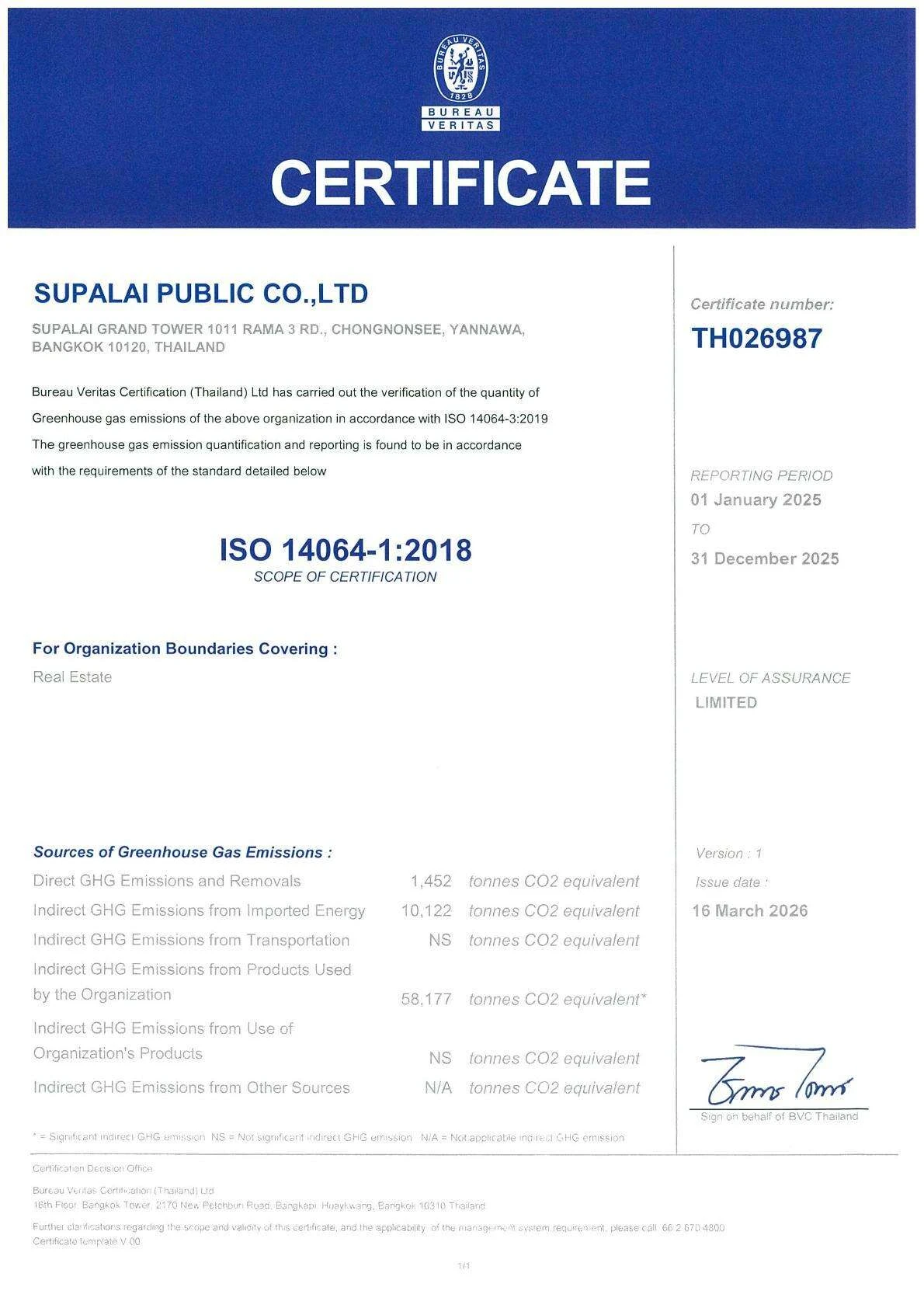
The company has prepared its organizational greenhouse gas emission and removal report for the period January 1 to December 31, 2025, certified according to international standard ISO 14064-1-2018, verified. Data by Company Bureau Veritas (Thailand) Ltd. which is a registered verifier
In the year In 2025, the company's total greenhouse gas emissions were 69,751 tCO2eq from operations, categorized as direct greenhouse gas emissions Scope 1 Quantity 1,452 tCO2eq and indirect greenhouse gas emissions from purchased electricity Scope 2 Quantity 10,122 tCO2eq, including direct and indirect greenhouse gas emissions Scope 1 and 2 quantity 11,574 tCO2eq, a decrease of 4.28% compared to the year 2024 This results from maximizing energy efficiency, reducing energy consumption in operational activities, and increasing the use of renewable energy in the organization's operational processes. The company also improved the management process of Supalai Grand Tower building, affecting direct and indirect greenhouse gas emissions Scope 1 and 2 emissions reduced in the year 2025
However, when calculating the ratio of direct and indirect greenhouse gas emissions to total revenue (Combined GHG scope 1&2 Intensity) of the year 2025 found to be equal to 0.4672 tCO2eq per million baht
The company has other indirect greenhouse gas emissions Scope 3 Total quantity 58,177 tCO2eq, a decrease of 30.57% compared to the year 2024
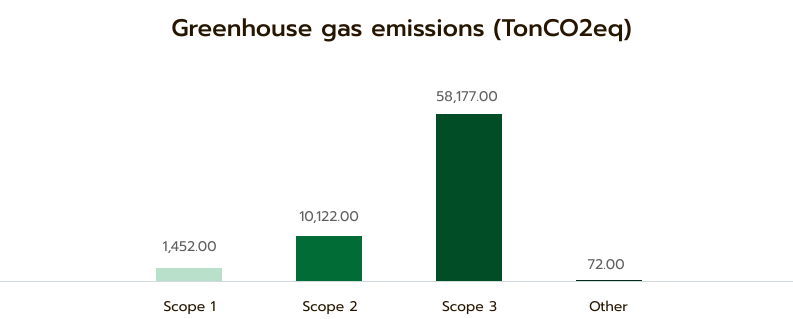
The company found that the top four activities in the supply chain with the highest other indirect greenhouse gas emissions are: Other indirect greenhouse gas emissions Scope 3 Indirect greenhouse gas emissions from purchased electricity Scope 2 and direct greenhouse gas emissions Scope 1 accounting for 83.41%, 14.51%, and 2.08% respectively.
| Greenhouse Gas Emission Sources | Unit | Quantity |
|---|---|---|
| Scope 1: Direct greenhouse gas emissions such as fuel, refrigerants, chemical fertilizers, fire extinguishing agents. | tCO2eq | 1,452 |
| Scope 2: Electricity consumption | tCO2eq | 10,122 |
| Scope 3 Cat.1 purchased goods and services | tCO2eq | 58,177 |
| Others (separate report) | tCO2eq | 72 |
| Total (Scope 1+2) | tCO2eq | 11,574 |
| Total (Scope 1+2+3) | tCO2eq | 69,751 |
| Output | million baht | 24,772 |
| Carbon Intensity (Scope 1+2) | tCO2eq / million baht | 0.4672 |
| Carbon Intensity (Scope 1+2+3) | tCO2eq / million baht | 2.8157 |
Greenhouse Gas Emission Statistics
| Operational Data | Unit | 2023 | 2024 | 2025 |
|---|---|---|---|---|
| Total greenhouse gas emissions | ||||
| Direct greenhouse gas emissions (Scope 1) | tCO2eq | 1,145 | 1,167 | 1,452 |
| Indirect greenhouse gas emissions (Scope 2) | tCO2eq | 9,085 | 10,925 | 10,122 |
| Other indirect greenhouse gas emissions (Scope 3) | tCO2eq | 133,750 | 83,797 | 58,177 |
| Greenhouse gas emissions (Scope 1+2) | tCO2eq | 10,230 | 12,092 | 11,574 |
| Greenhouse gas emissions (Scope 1+2+3) | tCO2eq | 143,980 | 95,889 | 69,751 |
| Ratio of greenhouse gas emissions to revenue (Scope 1 + 2) | tCO2eq / million baht | 0.3744 | 0.3781 | 0.4672 |
| Ratio of greenhouse gas emissions to revenue (Scope 1+2+3) | tCO2eq / million baht | 5.2695 | 2.9980 | 2.8157 |
3-Year Scope 3 Greenhouse Gas Emissions by Category
GHG Emission & Energy
| GRI | Indicators | Unit | 2023 | 2024 | 2025 |
|---|---|---|---|---|---|
| GHG Emissions | |||||
| 102-7 | Other indirect (Scope 3) GHG emissions (Cat.1) | Tons CO2e | 133,750 | 83,797 | 58,177 |
| 1. Purchased goods and services | Tons CO2e | N/A | N/A | 58,177 | |
| 2. Capital goods | Tons CO2e | N/A | N/A | N/A | |
| 3. Fuel- and energy-related activities | Tons CO2e | N/A | N/A | 2,289.25 | |
| 4. Upstream transportation and distribution | Tons CO2e | N/A | N/A | N/A | |
| 5. Waste generated in operations | Tons CO2e | N/A | N/A | 5.43 | |
| 6. Business travel | Tons CO2e | N/A | N/A | 44.13 | |
| 7. Employee commuting | Tons CO2e | N/A | N/A | 1,516.97 | |
| 8. Upstream leased assets | Tons CO2e | N/A | N/A | 0 | |
| 9. Downstream transportation and distribution | Tons CO2e | N/A | N/A | 0 | |
| 10. Processing of sold products | Tons CO2e | N/A | N/A | 0 | |
| 11. Use of sold products | Tons CO2e | N/A | N/A | 0 | |
| 12. End-of-life treatment of sold products | Tons CO2e | N/A | N/A | 0 | |
| 13. Downstream leased assets | Tons CO2e | N/A | N/A | 1,056.64 | |
| 14. Franchises | Tons CO2e | N/A | N/A | 0 | |
| 15. Investments | Tons CO2e | N/A | N/A | 0 | |