
Materiality Assessment


Supalai Public Company Limited recognizes the importance of conducting business with consideration for the Environment, Social, and Governance. Therefore, it has prepared sustainability business driving information to present management approaches and performance results on key sustainability issues to all stakeholder groups, covering economic, social, environmental, and governance dimensions. The information is presented from January 1 to December 31, 2025.
The company has reviewed material sustainability issues based on the principles of GRI Standards 2021 GRI 3: Material Topics 2021, which assesses material sustainability issues based on significant impacts on stakeholders, society, and the environment (Impact materiality) and significant impacts on the company. This includes a process for identifying material sustainability issues and linking data on driving sustainable business, analyzing and collecting data from all departments within the company to ensure consistency with the reporting guidelines of the GRI Sustainability Reporting Standards (GRI Standards), an international sustainability reporting standard, at the Core Option level and the United Nations Sustainable Development Goals (UNSDGs), to reflect factors affecting the organization's sustainable business operations in economic, social, and environmental dimensions, as well as responsibility towards all stakeholders. The company reviews change annually.
| Category | Details |
|---|---|

Analyze the context of the company and the industry.
|
Study and analyze activities within the supply chain conducted by the company and its business partners. Study external factors, global changes, economic, environmental, human rights, and social challenges at local, regional, and global levels related to the company and its business relationships. |

Identify impacts throughout the supply chain.
|
Identify actual and potential impacts on the economy, environment, and society, including impacts. Impact on human rights, arising from both company activities and business relationships, identifying both negative and positive impacts, short-term and long-term impacts, through brainstorming sessions, in-depth interviews, survey results, and complaints, as well as performance statistics. |

Assess the sign significant level of economic impact. environment, and society, including human rights.
|
Assess the significant level of impact by executives and experts in each field from internal departments, along with feedback from internal and external stakeholders through various channels, considering the severity of impact, nature of impact, and scope of impact. impact, likelihood, and ability to mitigate impacts, assessed separately for negative and positive impacts. |

Assess the significant level of impact on the company.
|
Group impacts on the economy, environment, and society, including human rights, into sustainability issues and consider likely material sustainability issues to assess their impact on the company. This is done by senior management, considering the likelihood and severity of the organization's sustainability impacts. |

Prioritize material sustainability issues.
|
Prioritize issues by setting cut-off points or criteria to determine which sustainability issues are highly material, high, medium, low, and very low. |

Review and Approval of Material Sustainability Issues
|
Verify the prioritization and accuracy of the process by the Risk Management Committee and external sustainability experts, and approve key sustainability issues by the Corporate Governance and Sustainable Development Committee and the Board of Directors, respectively. |
For more information please contact:
Risk management and Sustainable Development Department
Supalai Public Company Limited
1011 Supalai Grand Tower, Rama III, Chong Nonsi, Yannawa, Bangkok 10120
Tel. +66 2 725 8888
Email: ESG@supalai.com
The company assigns the risk management department to continuously present material sustainability issues to the Risk Management Committee for consideration according to the scheduled meeting plan. The committee has resolved to summarize material sustainability issues as follows:
Identification of Material Issues
Economy

Environment

Society

Governance
Identify Impacts throughout the Supply Chain
| Sustainability Dimension | Sustainability Issues | Impacts on Stakeholders | |||||
|---|---|---|---|---|---|---|---|
| Customers | Employees | Suppliers / Contractors | Shareholders | Community | Government Agencies | ||
| Economy | 1. Supply chain |  |
|
|
|
|
|
| 2. Tax-related Operations | |
|
|
||||
| 3. Business and Social Innovation | |
|
|
|
|
||
| Environment | 4. Biodiversity and Ecosystem Conservation |  |
|
|
|
|
|
| 5. Resource Utilization | |
|
|
|
|
|
|
| 6. Climate Action | |
|
|
|
|
|
|
| Society | 7. Consumers Responsibility |  |
|
|
|
|
|
| 8. Community and Social Development | |
|
|
|
|
|
|
| 9. Respect for Human Rights and Fair Treatment of Labour | |
|
|
|
|
||
| 10. Capacity Enhancement for Employees and Workers in Work and Daily Life | |
|
|
|
|||
| 11. Safety, Occupational Health, and Working Environment | |
|
|
|
|
|
|
| Governance | 12. Corporate Governance |  |
|
|
|
|
|
| 13. Risk Management | |
|
|
|
|
|
|
| 14. Anti-Corruption | |
|
|
|
|
||
 Assess the Significant Level of Impact on the Company
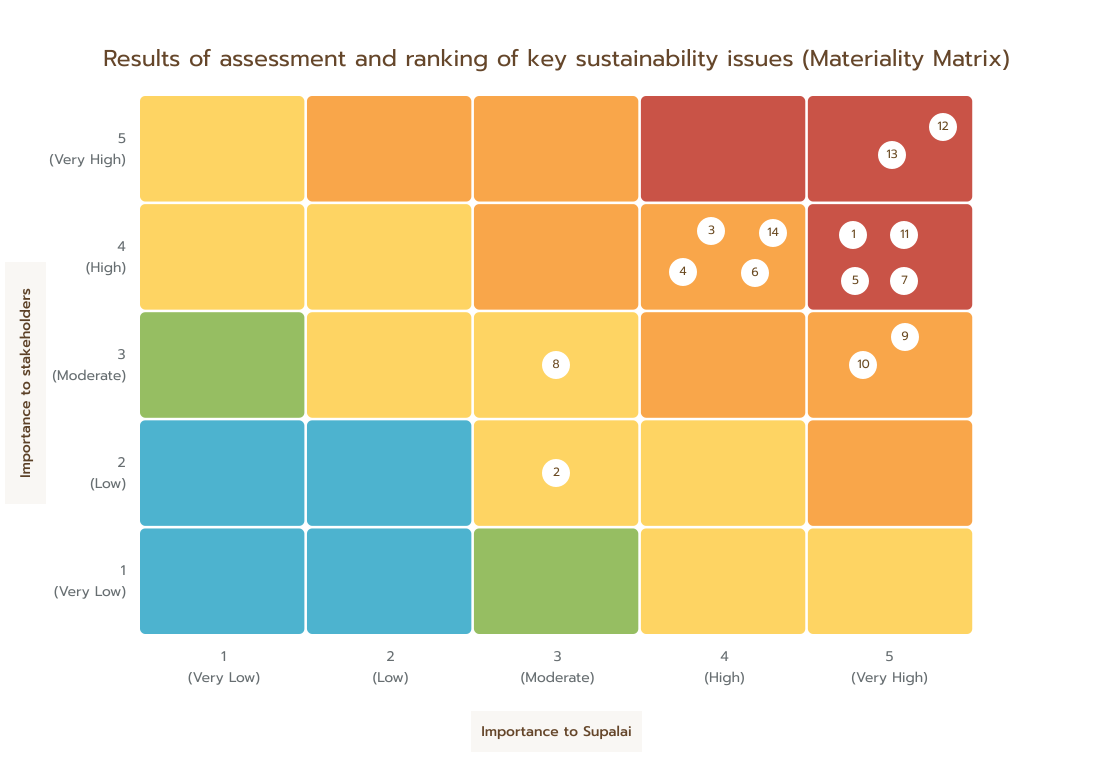
The company has a total of 14 material sustainability issues, with their materiality ranked using a Materiality Matrix. There are 6 issues identified as highly material. Details of the management of all 14 material sustainability issues are disclosed in this 56-1 e-One report for 2025.
Prioritization of Material Sustainability Issues
The company presents the identified material sustainability issues in the Materiality Matrix as follows:
Highly Material Issues
Highly Material Issues
Highly Material Issues
Management of Material Sustainability Issues
Material Sustainability Issues
Governance
Risk Management Committee
Oversee the assessment of significant supplier/external contractor risks.
Corporate Governance and Sustainable Development Committee
Oversee the Supplier Code of Conduct to cover ESG issues and supply chain management.
Goals / Indicators 2025
Maintain capable suppliers and contractors to ensure customer contract cancellations due to substandard products and services do not exceed 0.5% of total sales contracts.
Operational Outcome
Achieved target; customer contract cancellations due to substandard products and services remained below 0.5%
Strategy / Approach Operations
- Supplier onboarding and selection prioritizing ESG declaration.
- Risk assessments of suppliers and contractors on material supply chain and ESG issues, including site visits.
- Contractor training to ensure work quality in line with Company standards One Standard, One Quality.
- Initiatives to enhance workers’ quality of life at project sites (e.g., Happiness Camp and welfare facilities).
- Product Selection Committee to ensure product quality and suitability.
- Facilitating access to construction materials at reasonable prices for contractors.
- Factory visits to assess production systems, delivery readiness, and ESG practices.
- Price control through benchmarking with international market data.
- Monitoring global raw material trends for inventory and procurement planning.
- Stakeholders focus groups on corporate image, products, services, governance, climate response, and risk management.
- Participation in CAC Change Agent Day to promote business integrity and anti-corruption practices.
Risks and Opportunities
| Business | Stakeholders |
|---|---|
|
Key Risk
Risk Appetite [2] : Low
Risk Appetite [3] : Moderate Opportunity
|
Opportunity Sustainable supply chain practices deliver long-term benefits to customers and stakeholders in terms of product quality, pricing, and after-sales services, supporting continuous sustainability. |
Material Sustainability Issues
Governance
Board of Directors
Tax Operations Policy
Goals / Indicators 2025
No fines are incurred from tax errors or careless tax operations.
Operational Outcome
No tax penalties incurred from errors or non-compliance.
Strategy / Approach Operations
- Ensure accurate and complete tax compliance in accordance with applicable laws and regulations
- Monitor changes in tax laws, rules, and regulatory requirements
- Avoid inappropriate or non-compliant tax structures
- Engage external tax advisors to ensure proper tax practices
Risks and Opportunities
| Business | Stakeholders |
|---|---|
|
Key Risk Potential inaccuracies or incomplete tax filings. Risk Appetite [1] : Very Low Opportunity Strengthening a culture of transparency in alignment with good corporate governance principles. |
Opportunity Full and accurate tax contributions to the government support continuous national development, generating positive returns for the Company and all stakeholders. |
Material Sustainability Issues
Governance
Executive Committee
- Support the expression of ideas and innovative thinking among employees
- Provide resources related to innovation development.
Goals / Indicators 2025
- At least 50% of award-winning innovations are practically implemented.
- Increased use of environmentally friendly materials and innovations to reduce waste and environmental impacts.
- Continuous recognition through external awards.
Operational Outcome
- 56% of award-winning innovations (5 out of 9) in 2024 have been implemented; the remaining 44% are under development.
-
Increased adoption of environmentally friendly materials and technologies, including:
- Low GHG products (e.g., Green Products, low CFP, low VOC paints)
- Painting innovations reducing multiple coating layers and eliminating primers
- Installation of air filtration (airflow) systems in residential units
- Recycling roof tile waste into
- paving materials.
-
Received 8 external awards, including:
- Product of the Year Award 2025 Supalai Elite Sukhumvit 39Masterplan for Thailand Supalai Lagoon Hua Hin (Asia Pacific Property Awards 2025)
- Best Affordable Quality Awards Home (Living Insider Developer Awards 2025)
- Best Concept Design Awards Condo (Living Insider Developer Awards 2025)
- FIABCI Thai Prix Excellence Awards 2025 (Condominium category)
- Elite Winner Hubexo Asia Awards 2025
- Green Innovation Award
- Energy Efficiency Label (No.5) Certification Electricity
- Generating Authority of Thailand.
Strategy / Approach Operations
Environmental
- Establish sustainable interior design guidelines Sustainable Interior Design.
- Continuous use of environmentally certified materials (Green Products).
- Innovations to reduce construction waste (e.g., recycling lightweight bricks for
- landscaping).
- Upcycling paint containers for organic waste composting to replace chemical fertilizers.
- Promoting energy-saving innovations (e.g., EV charging stations).
- 100% recycling of gypsum waste from construction processes.
- Use of reusable plastic pallets to replace wooden pallets.
- Reuse concrete waste for temporary on-site roads.
- Use of cut-to-size pipes and fittings to minimize material waste.
- Collaboration with partners to develop low-coat, primer-free paints.
- Development of water filtration systems in storage tanks to improve water quality.
- Innovation in multifunctional waste bins with integrated mailbox and parcel features.
Social
- Upcycling lightweight brick waste into aroma stones to generate income for local communities.
- Supporting employee participation in innovation-related training and seminars (internal and external).
- Organizing HACKATHON C2C TECH X BY SUPALAI 2025 in collaboration with Suranaree University of Technology.
Business
- Digital Mortgage Innovation project in collaboration with banks to enhance loan approval efficiency and reduce documentation processes.
- SUPALAI EXPERIENCE HOME: construction innovation initiative.
- Innovation Award program to encourage internal innovation.
- Research and analysis of real estate innovations to enhance product development.
- Utilization of consumer behavior research to drive value-added innovations.
- Continuous participation in external innovation competitions.
Risks and Opportunities
| Business | Stakeholders |
|---|---|
|
Key Risk Insufficient monitoring and execution in implementing award-winning innovations by responsible functions. Risk Appetite [2] : Low Opportunity
|
Opportunity
|
Material Sustainability Issues

Governance
- Corporate Governance and Sustainable Development Committee
- Organizational Sustainability Management Policy
Goals / Indicators 2025
- Business operations support the reduction of negative impacts on ecosystems and biodiversity through stakeholder engagement.
- Green space in low-rise projects ≥5% of saleable area.
Operational Outcome
- No complaints regarding project impacts on biodiversity and ecosystems.
- All low-rise projects maintained green space of at least 5% of total saleable area.
Strategy / Approach Operations
- Conduct site assessments and prepare Initial Environmental Examination (IEE) and Environmental Impact Assessment (EIA) reports.
- Establish grievance channels for biodiversity and ecosystem impacts at project sites and communicate to nearby stakeholders.
- Comply with Company standards aligned with expert review committee requirements for EIA (buildings, land allocation, and community services).
- Treat wastewater to meet regulatory standards prior to discharge. Implement community communication plans on impact mitigation, remediation measures, and monitoring results.
- Preserve existing trees within project areas and replant within Company developments.
- Utilize native plant species in project landscaping.
- Organize reforestation activities (e.g., Forest for Well-being initiative).
- Conduct biodiversity risk assessments and implement mitigation plans.
- Establish guidelines for tree relocation and transplantation.
- Use natural or treated water for landscape maintenance to reduce potable water consumption.
- Convert organic waste (leaves and branches) into compost to replace chemical fertilizers and improve soil quality.
- Apply bio-fermented solutions to enhance soil quality and plant growth without chemicals.
- Utilize organic fertilizers to reduce chemical fertilizer usage.
- Reuse existing soil within project areas to preserve ecosystems and enhance biodiversity.
- Collaborate with government agencies on conservation of rare species, microbial solutions, and organic composting.
- Organize environmental volunteer activities (e.g., coastal clean-up and marine conservation support).
Risks and Opportunities
| Business | Stakeholders |
|---|---|
|
Opportunity Enhancing operational management to minimize impacts on biodiversity and ecosystems, while mitigating reputational risk. |
Key Risk Potential impacts from construction activities on ecosystems and the environment, leading to biodiversity loss. Risk Appetite [2] : Low |
Material Sustainability Issues
Governance
- Corporate Governance and Sustainable Development Committee
- Efficient Resource Utilization Policy
Goals / Indicators 2025
- Reduced resource consumption at the Company’s headquarters as follows:
- Promote waste segregation through the Waste Separation campaign and Recycle Day at headquarters, contributing to carbon reduction of at least 10 TonCO2e per year.
Operational Outcome
-
Reduced resource consumption at the Company’s headquarters as follows:
2023 2024 2025 Water Consumptions (unit) 104,374 107,060 92,995 Electricity Consumption (Unit) 4,086,669 3,593,629 2,717,859 -
Sort more, benefit more waste segregation project at the headquarters building, in collaboration with Recycle Day.
- 2024: A total of 787.90kg of waste was separated, reducing carbon emissions by 2.61 TonCO2e, equivalent to 275 trees planted.
- 2025: A total of 2,764.15 kg of waste was separated, reducing carbon emissions by 15.33
- TonCO2e, equivalent to 1,487 large trees planted.
Strategy / Approach Operations
Resource Utilization
- Replacement of 9W LED 6,400K light bulbs in common areas and restrooms at the Company’s Supalai Grand Tower to reduce electricity consumption.
- Reuse of wastewater from the air conditioning system at the head office for watering plants and cleaning road surfaces.
- Replacement of street lighting poles in project common areas with solar-powered lighting (Solar Cell) to reduce electrical wiring and electricity consumption, helping lower common area expenses.
- Green building management at Icon Sathorn to enhance efficient water and energy utilization, with the office area certified under LEED Certified.
- Implementation of energy-saving innovations such as Motion Sensor, Heat Wheel Energy Recovery, Precooled Evaporator, UVC air-conditioning disinfection system, Building Management System (BAS), and Lift Destination.
- Replacement of the chiller system to improve cooling efficiency, together with the installation of CPMS (Chiller Plant Management System) to control and manage the cooling system based on actual load usage and enable real-time monitoring to reduce energy consumption.
- All real estate development projects launched in 2025 utilize water-saving fixtures and sanitary equipment.
- Replacement of sanitary fixtures with water-saving models at the head office.
- Improvement of wastewater treatment system at the head office.
- Optimization of electricity load to improve energy efficiency.
- Improvement of equipment to reduce energy consumption in the wastewater treatment system.
- Increased adoption of electric vehicles (EVs) and hybrid vehicles to replace fuel powered vehicles.
- Installation of EV charging stations within the building.
- Collaboration with Pankan Project to collect donated unused items for resale, with proceeds supporting scholarships for children under the Yuvabadhana Foundation.
- Implementation of the Care the Bear Eat It All Reduce Global Warming (No Food Waste) campaign.
- Organization of activities and campaigns to encourage employee and supplier participation in resource efficiency, such as PALI Supplier Day and waste separation campaigns.
- Use of natural water sources within project areas or treated water to replace tap water for landscape maintenance in project common areas.
- Adoption of Virtualization and Cloud Services in place of physical servers to reduce energy consumption.
- Providing knowledge and awareness on energy conservation through the Company’s online platforms such as Facebook, TikTok, and Instagram.
- Elevator system management through the installation of EMS (Energy Management System) to monitor elevator operations and the replacement of existing elevators with the energy-efficient Regent model.
- Installation of VSD (Variable Speed Drive) in water pump systems to control operational speed and reduce energy consumption according to actual usage.
- Replacement of snack and fruit packaging used in training sessions and meetings with
- environmentally friendly containers.
Waste Management
- Implementation of The More You Separate, The More You Gain waste separation project in collaboration with Recycle Day, achieving a carbon footprint reduction of 15.33 Ton2CO e, equivalent to 1,487 trees planted.
- Implementation of the E-Waste project in collaboration with Advanced Info Service (AIS), collecting 20 kg of electronic waste, equivalent to a carbon footprint reduction of 0.123 Ton2COe or 14 trees planted.
- Recycling of used sealant tubes into various products such as chairs, plant pots, and coasters.
- Employee uniforms produced from recycled plastic totaling 97,720 pieces, reducing carbon emissions by 9.772 TonCO2e, and reducing ironing-related energy use by 36 Ton2COe per year, totaling 35.13 Ton2COe, equivalent to 3,652 trees planted.
- Implementation of the SUPALAI SELF PROVED project to measure construction waste generated from the Company’s projects, aiming to reduce waste through construction innovation and improved planning under the Waste Management initiative.
- Waste separation within projects into eight categories: organic waste, plastic, glass bottles, foam, paper, cans, plastic bottle caps, and food waste, with hazardous waste separated from non-hazardous waste for proper disposal and measurable outcomes.
- Campaigns and awareness programs for residents within projects include providing color-coded waste bags based on waste categories.
- Reuse of lightweight brick scraps to produce Aroma Stones, reducing greenhouse gas emissions by 0.002 kgCO e per piece, which are used as souvenirs in Company events.
- Implementation of the New Gen Zero Waste project to separate recyclable waste.
- Participation in climate-related initiatives and programs with external organizations.
- LEED certification (Leadership in Energy and Environmental Design) for the office building at Supalai Icon Sathorn.
Risks and Opportunities
| Business | Stakeholders |
|---|---|
|
Key Risk Employees may lack consistency and sustainable implementation of efficient resources utilization, energy conservation, and waste management practices in them daily lives. Risk Appetite [2] : Low Opportunity Planning resources utilization, including the adoption of innovations in production processes, to enhance resource efficiency and reduce impact on the climate, which may otherwise lead to natural changes that could adversely affect overall business operations. |
Opportunity Promoting efficient resources utilization habits among employees, extending to their families and society. |
Material Sustainability Issues
Governance
Corporate Governance and Sustainable Development Committee Organizational Sustainability Management Policy
Goals / Indicators 2025
- Reduce Scope 1 and Scope 2 greenhouse gas (GHG) emissions by 40% from the Business-as-Usual (BAU) baseline by 2030.
- Achieve ISO 14064-1:2018 certification for organizational GHG emissions reporting.
- Obtain certification from the Thailand Greenhouse Gas Management Organization (TGO) for organizational carbon footprint disclosure.
Operational Outcome
- Total Scope 1 and Scope 2 GHG emissions amounted to 11,574 TonCO2e, representing a 4.28% reduction compared to 2024.
- Achieved ISO 14064-1:2018 certification for organizational GHG emissions reporting (March 2025).
- Achieved TGO certification for organizational carbon footprint disclosure (May 2025).
Strategy / Approach Operations
- Participation in climate-related initiatives and programs with external organizations.
- LEED certification (Leadership in Energy and Environmental Design) for the office building at Supalai Icon Sathorn.
Operational Outcome
- Reforestation initiative Forest for Wellbeing with 36th Anniversary, Prachuap Khiri Khan.
- Chiller system replacement to improve energy efficiency and reduce emissions.
- Installation of EV charging stations at Supalai Grand Tower and Supalai Icon Sathorn.
- Gradual transition to electric and hybrid vehicles for corporate fleet.
- Adoption of mineral-based pool systems to reduce chemical usage.
- Upcycling paint containers for organic waste composting to replace chemical fertilizers.
- Installation of solar-powered street lighting to reduce electricity consumption.
- Solar roof projects for sales offices, construction offices, clubhouses, show units, and parking areas.
- Adoption of low-carbon materials and technologies in construction and product development.
- Use of hydraulic cement to reduce CO emissions.
- Use of certified green materials (e.g., SCG Green Choice).
- Selection of low GHG products (e.g., low CFP, low VOC paints).
- Participation in Care the Bear initiative to reduce carbon footprint.
- Communication and awareness campaigns to achieve 40% GHG reduction target by 2030.
- Preservation and relocation of existing trees within project areas.
- Waste reduction campaigns for residents, including color-coded waste segregation.
- Use of environmentally friendly cleaning products.
- Use of organic fertilizers combined with chemical fertilizers to reduce environmental impact.
- Employee uniforms made from recycled plastic, reducing 35.01 TonCO2e (equivalent to 3,640 trees)
Risks and Opportunities
| Business | Stakeholders |
|---|---|
|
Key Risk
Opportunity Climate change challenges create Opportunity for the development of new products and improved business management approaches aligned with the Company’s operations. |
The impacts of Climate change are becoming increasingly severe, including flooding from intensified rainfall, rising sea levels due to polar ice melt, heatwaves, and droughts. |
Material Sustainability Issues
Governance
Corporate Governance and Sustainable Development Committee
- Customer Treatment Policy
- Personal Data Protection Policy
Quality System Review and Improvement Committee Quality Policy
Goals / Indicators 2025
No final court rulings indicating intentional
unfair treatment of consumers.
Operational Outcome
In 2025, there were no final court rulings indicating intentional unfair treatment of consumers.
Strategy / Approach Operations
- ISO 9001:2015 certification covering endto-end processes, including delivery and aftersales services.
- Extended warranty periods for condominium and low-rise projects beyond legal requirements.
- Customer complaint, feedback, and maintenance request channels via hotline (1720) and online platforms.
- Continuous development of the Supalai Sabai application.
- Provision of certified technician listings (e.g., electrical, plumbing, interior works) via Supalai Sabai.
- Customer knowledge sharing through various channels (e.g., Supalai Sabai).
- Supalai Privilege Program offering discounts on healthcare, appliances, and moving services.
- Promotion of solar roof adoption through Supalai Sabai Marketplace.
- LINE OA: Supalai Care Providing guidance on home and condominium maintenance.
- Green Home Loan Program in collaboration with financial institutions, offering preferential interest rates.
- Use of project areas for community planting (e.g., vegetables and seasonal flowers).
- Waste segregation awareness campaigns with provision of color-coded waste bags.
- Customer surveys on satisfaction, behavior, and feedback to enhance products
- and services.
- Customer assistance programs during disasters (e.g., earthquakes, floods).
- Collaboration with partners to provide discounts on construction materials for affected customers.
- Share of the Month initiative within construction team meetings to share best practices.
- Peer Reporting program as a channel for reporting issues or risks to ensure timely resolution for customers.
Risks and Opportunities
| Business | Stakeholders |
|---|---|
|
Key Risk Potential failure to meet product quality standards. Risk Appetite [1] : Very Low Opportunity
|
Opportunity Enhancing customer satisfaction across key aspects, including quality of life, safety, and value for money. |
Material Sustainability Issues
Governance
Corporate Governance and Sustainable Development Committee
Social Treatment Policy
Goals / Indicators 2025
Conduct at least 15 social and community development activities per year.
Operational Outcome
In 2025, more than 19 social and community development activities were conducted.
Strategy / Approach Operations
Community and Social Support Activities
-
Panrak Project:
- Collection and donation of relief items for flood victims in Northern Thailand, such as clothing, dried food, and cleaning supplies, through the Mirror Foundation.
- Special Panrak Project campaign providing relief items for flood victims in Hat Yai in collaboration with Tham-Dee Foundation.
- Waen Sang Suk Project: Eye examinations and eyeglasses provided to workers, contractors, suppliers, and nearby communities, achieving 152% of the target.
- Nong Suk Dee, Pee Suk Jai Project: Health check-ups and influenza vaccinations provided to children of construction workers and children in nearby communities, achieving 177% of the target.
- Pan Aun Klai Nao Project: Provision of essential supplies to help underprivileged students cope with cold weather caused by changing climate conditions. Pankan Project: Donation of unused items for resale, with proceeds supporting scholarships for children under the Yuvabadhana Foundation.
- Suan Phak Srang Dee Project: Transformation of unused school space into fruit and vegetable gardens, including seed planting, organic fertilizer production, and income-generating skills development for students and nearby communities at Ban Chakna School, Chonburi Province.
- Environmental activities such as the Pa Sang Suk Project (3rd edition).
-
Education Development Activities under the Supalai Srang Dee Project:
- Establishment of the Huen Srang Dee Learning Center as a hub for childrens learning and activities, along with scholarships for outstanding students at Ban Muang Ka School, Chiang Mai Province.
- Supalai Srang Dee Transforming Open Spaces into Playgrounds Project: Renovation of deteriorated activity areas into safe learning spaces, including activity yards, playgrounds, reading cabins, and football fields for the New Khlong Toei Development Community.
- Support for the BAS CAMP OF GEN social development volunteer camp organized by the Faculty of Business Administration for Society, Srinakharinwirot University.
- Support for Engineering Open House 2025 organized by the Faculty of Engineering, Thammasat University.
- Participation in the Big Brother Project with the Thai Chamber of Commerce to strengthen the capabilities of new-generation Thai entrepreneurs through coaching and mentoring.
- Scholarship grants provided in 2025
Job Creation for Communities and Society
- Local employment within project areas, hiring residents from nearby communities or provinces for roles such as gardeners, housekeeping staff, and security personnel.
- Recycling of crushed lightweight brick scraps into Aroma Stones, generating income for the Amban Community Enterprise in Mae Hong Son District, Chiang Rai Province.
- Internship programs for university students.
- Employment Opportunity for people with disabilities.
- Knowledge-sharing activities as guest speakers in collaboration with local organizations such as schools and communities to promote development, awareness, and income generation for society.
Risks and Opportunities
| Business | Stakeholders |
|---|---|
|
Key Risk Community and social development activities may lack continuity in implementation. Risk Appetite [2] : Low Opportunity
|
Opportunity
|
Material Sustainability Issues
Governance
Nomination and Remuneration Committee
- Human Rights Policy
- Remuneration and Benefits Policy
Goals / Indicators 2025
- No employee complaints related to human rights violations or unfair labour practices.
- No human rights impacts arising from suppliers business operations.
Operational Outcome
- In 2025, no complaints were reported regarding human rights violations or unfair labour practices.
- In 2025, no human rights complaints were associated with suppliers business operations.
Strategy / Approach Operations
- Adoption of Human Rights Due Diligence (HRDD) guidelines from the Securities and Exchange Commission of Thailand (SEC) to prevent and mitigate human rights risks, including ensuring internal implementation of policies.
- Assessment of human rights risks and impacts across the Company’s operations, suppliers, contractors, and external parties, including remediation, mitigation, and grievance mechanisms for violations or unfair labour practices.
- Human rights training programs for employees and business partners, covering topics such as human rights in the real estate sector, positive discipline for modern supervisors, and policies on misconduct and
- Compliance with labor relations and welfare standards, receiving recognition as an outstanding establishment in 2025 from the Department of Labour Protection and Welfare.
- Protection of privacy rights, including personal data protection (PDPA).
- Provision of fair, inclusive, and sustainable compensation and benefits.
- Revision of Company regulations to align with human rights principles and fair labor practices.
- Provision of essential and equitable employee welfare.
- Promotion of equal employment Opportunity without discrimination (e.g., disability, gender identity, age, religion, race).
- Integration of human rights criteria into procurement processes.
- Establishment of grievance channels on human rights and fair labor practices via email (Employee_feedback@supalai.com), with direct oversight by senior management
Risks and Opportunities
| Business | Stakeholders |
|---|---|
|
Key Risk
Risk Appetite [1] : Very Low
Risk Appetite [1] : Very Low Opportunity
|
Opportunity
|
Material Sustainability Issues
Governance
Nomination and Remuneration Committee
- Employee Development Policy
- Employee Treatment Policy
Goals / Indicators 2025
- At least 90% of employees participate in the performance competency assessment as defined by the Company.
- At least 80% of employees participating in the competency assessment have an Individual Development Plan (IDP).
Target (2030)
100% of employees are assessed on the skills required for both current and future roles and participating in the Company’s employee development programs (starting in 2026).
Operational Outcome
- In 2025, 98% of employees participated in the competency assessment as defined by the Company.
- In 2025, 83% of employees who participated in the competency assessment had Individual Development Plans (IDPs).
Strategy / Approach Operations
Training and Employee Development
- Annual training plan.
- Individual Development Plans (IDPs).
- Participation of employees in external training programs organized by professional and regulatory institutions (e.g., the Stock Exchange of Thailand, the Engineering Institute of Thailand, and the Department of Skill Development), including joint training with business partners.
- Professional and construction standards training for engineers, maintenance technicians, and contractors.
- Organization-wide capability development through the Agile Program.
- Competency and behavioral assessments based on Agile Competency principles.
- On-the-job training and coaching.
- Gamification-based learning through the Supalai Life platform.
- Cybersecurity awareness training for employees and executives.
- Digital skills capability assessment linked to the sustainability pillar on Innovation under the DIGITAL Capability Assessment program.
- Technical skills training (e.g., AI Forum, Data-Driven Decision Making for Enhanced Productivity, and construction safety).
- Cross-functional professional skills training. Diversity & Inclusion
-
ESG and ethics training, including:
- ESG: Closer Than You Think.
- ESG: The First Step Toward Sustainability.
- Waste segregation and management.
- Anti-corruption.
- Diversity & Inclusion.
- Fundamentals of corporate sustainability and sustainable development.
- Human rights for the real estate sector.
- Seminar on Positive Discipline for Modern Supervisors.
- Training on policies regarding misconduct and harassment.
- Online learning programs under
- Supalai x SkillLane.
Activities and Benefits Supporting Employee Development
- Scholarship programs.
- Employee welfare and essential benefits.
- Employee engagement survey program.
- Welfare Committee and Supalai Relations Club.
- Competitive compensation benchmarking with industry standards.
- SPL Book Club program, including book recommendations, board games, and a book lending service.
- Talent and successor development programs.
- Activities promoting awareness of Agile Way behaviors.
- Environmental awareness initiatives are embedded in the corporate culture.
- Recruitment and development of future leaders through the Manager Trainee program.
Risks and Opportunities
| Business | Stakeholders |
|---|---|
|
Key Risk
Opportunity
|
Opportunity
|
Material Sustainability Issues
Governance
- Corporate Governance and Sustainable Development Committee
- Safety, Occupational Health, and Working Environment Policy.
Goals / Indicators 2025
- Zero work related fatalities among employees.
- Zero severe work-related injuries among employees.
Operational Outcome
In 2025, there were no work-related accidents resulting in severe injury, permanent disability, or fatalities among employees.
Strategy / Approach Operations
- Establishment and annual review of the Company’s safety policy.
- The Safety Committee conducts inspections, gathers findings, and reports improvement measures to management.
- Safety inspections conducted by the Safety Committee, management team, internal audit, and IQA.
- Monthly safety inspection checklists for project safety officers, with results reported at the monthly project meeting.
- Occupational safety manuals and guidelines.
- Installation of safety signage at construction site entrances to raise awareness and enforce safety practices.
- All Safety Committee members attend certified training on occupational safety, health, and working environment for establishments.
- Training programs for Executive-Level Safety Officers for supervisory-level employees to oversee workplace safety.
- Training on occupational safety, health, and working environment for all new employees.
- Establishment of a Business Continuity Plan (BCP) and Disaster Recovery Plan (DRP).Firefighting training provided to at least 40% of employees in each area.
- Annual fire evacuation drills for employees.
- Provision of safety equipment for employees and suppliers.
- Annual SAFETY GAME and SAFETY COIN activities to raise awareness of occupational safety, health, and working environment.
- Engagement with suppliers to promote and implement safety practices within their operations.
Risks and Opportunities
| Business | Stakeholders |
|---|---|
|
Key Risk
Risk Appetite [1] : Very Low
Risk Appetite [1] : Very Low Opportunity Continuous improvement in safety risk management, strengthening the Company’s safety performance and corporate reputation. |
Opportunity
|
Material Sustainability Issues
Governance
Corporate Governance and Sustainable Development Committee
- Policy on Treatment of Shareholders, Customers, Partners, Creditors, Competitors.
- Consider approving the Employee Code of Conduct.
- Oversee compliance with good corporate governance criteria.
- Support and promote knowledge dissemination.
- Internal Information Usage Policy.
- Conflict of Interest Policy.
- Policy on Reporting Conflicts of Interest.
- Information Disclosure and Public Dissemination Policy.
Goals / Indicators 2025
- Received a 5-Star CG Rating.
- Received the ASEAN Asset Class PLCs Award under the ASEAN CG Scorecard.
- Received the Outstanding Ethics Award from the Thai Chamber of Commerce.
Operational Outcome
- Received a 5-Star CG Rating (Excellent Category) in 2025, for the 13th consecutive year.
- Received the ASEAN Asset Class PLCs Award under the ASEAN CG Scorecard for 2024, with the results announced in July 2025.
- Received the Outstanding Ethics Award from the Thai Chamber of Commerce (23rd year), in 2025.
Strategy / Approach Operations
- Assessment of employees ESG awareness across three dimensions, with results analyzed using SPSS and PAM (Marketing Automation Platform) and reported to the Corporate Governance and Sustainable Development Committee.
- ESG training for employees through the Supalai Coin Next platform: ESG Journey The First Step Toward Sustainability.
- Improvement of the Corporate Governance Policy and Code of Conduct to enhance clarity and readability.
- Achievement of a full score (100 points) in the AGM Checklist for the 13th consecutive year.
- Knowledge assessment tests for employees on corporate governance, internal control, and anti-corruption.
-
Implementation of corporate governance practices with monitoring, evaluation, and reporting processes covering:
- Shareholder rights and equitable treatment of shareholders.
- Treatment of stakeholders.
- Disclosure and transparency.
- Responsibilities of the Board of Directors.
- Communication of corporate governance knowledge through employee-friendly materials.
- Communication of corporate governance knowledge through employee-friendly materials.
- Disclosure of conflicts of interest.
- Employees are required to acknowledge and sign the Code of Conduct and Company policies through the Supalai Skills platform to ensure understanding and compliance with corporate governance principles.
Risks and Opportunities
| Business | Stakeholders |
|---|---|
|
Key Risk Operations may not comply with the requirements of the Stock Exchange of Thailand and external regulatory authorities. Risk Appetite) [2]: Low Opportunity Establishing a strong foundation for sustainable business operations. |
Opportunity
|
Material Sustainability Issues
Governance
Risk Management Committee
- Define material sustainability issues.(Key Materiality).
- Assess the impact of sustainability issues on stakeholders.
- Prioritize material sustainability issues (Materiality Matrix).
- Define policies and propose risk management approaches.
- Define Key Risks.
- Assess Risk Level.
- Define acceptable risk levels (Risk Appetite).
- Define risk indicators.
- Table showing assessment of likelihood and impact (Risk Matrix).
- Provide advice / define policies and propose additional risk management approaches to line managers (Risk Mitigation Plan).
- Support activities to build knowledge and understanding of risk management.
- Oversee the emergency response plan.
- Provide a platform for stakeholder feedback
Goals / Indicators 2025
Assessment and establishment of risk management plans for key enterprise risks and sustainability-related risks of the Company, achieving a SET ESG Ratings score of 95 in the Risk and Crisis Management category from the Stock Exchange of Thailand (SET).
Operational Outcome
The sustainability assessment result in risk management from the Stock Exchange of Thailand in 2025 scored 89 points in the Risk and Crisis Management category.
Strategy / Approach Operations
- Risk management covers sustainability issues (ESG Risks) and enterprise risks, including strategic, operational, financial, regulatory, cyber, and emerging risks.
-
Annual risk review conducted by the Risk Management Unit and relevant departments, considering risks from:
- Internal factors (SWOT Analysis).
- External factors (PESTEL Analysis), including business environment surveys based on various statistics.
- Global risk reports such as the Global Risks Report by the World Economic Forum.
- Annual focus group discussions with external stakeholders on topics such as product image, services, governance, sustainability, corporate image development, risk assessment, and stakeholder expectations to support sustainable development (Environmental, Social and Governance: ESG).
- Other stakeholder feedback channels.
- Review by the Risk Management Committee to consider risk mitigation measures in line with the Company’s risk appetite (presented four times per year), with monthly updates reported to the committee via the Group Line platform.
- Risk management is also implemented at the departmental level and reviewed annually.
-
Initiatives to promote enterprise-wide risk management practices, including:
- Risk-Based Audit processes.
- Assessment of employee’s knowledge on risk management.
- Communication of risk management knowledge through easy-to-understand materials
Risks and Opportunities
| Business | Stakeholders |
|---|---|
|
Key Risk The Company’s risk assessment may not fully cover all significant risks arising within the organization. Risk Appetite) [2] : Low Opportunity
|
Opportunity Stakeholders receive both direct and indirect benefits from the Company’s risk management practices across social, environmental, and economic aspects. |
Material Sustainability Issues
Governance
Audit Committee
-
Oversee compliance with the self-assessment criteria for CAC certification, including consideration of policies related to anti-corruption, as follows:
- Risk Assessment
- Anti-Corruption Risk Prevention Measures
- Policies and Practices
- Personnel Management
- Communication
- Whistleblowing
- Review and Audit
- Receiving complaints and defining solutions to prevent recurrence.
Corporate Governance and Sustainable Development Committee
Ensure that the Supplier Code of Conduct includes anti-corruption issues.
Board of Directors
Oversee compliance with the anti-corruption enhancement plan of the JUMP+ project.
Goals / Indicators 2025
- No complaints related to corruption.
- Maintain 3 Star CAC status.
- Receive the CAC Change Agent Award continuously.
Long-term Plan (2028).
- Achieve the 3rd consecutive renewal of certification as a member of the Thai Private Sector Collective Action Against Corruption (CAC).
- At least two suppliers that declare their commitment to CAC obtain CAC certification.
Operational Outcome
- In 2025, no complaints related to corruption was reported.
- The Company received CAC 3 Star status for the 4th renewal of certification from the Thai Private Sector Collective Action Against Corruption (CAC) in 2025.
- The Company received the CAC Change Agent Award in November 2025.
Strategy / Approach Operations
- Implementation of anti-corruption measures in accordance with the CAC assessment conducted by the Thai Institute of Directors Association (IOD).
- Monitoring and compliance with the criteria of the Thai Private Sector Collective Action Against Corruption (CAC).
- Received the CAC Change Agent Award for the 4th consecutive year, with the award ceremony held on 24 November 2025.
- At least two suppliers that declare their commitment to CAC obtain CAC certification within three years (2025-2028).
- At least 10 SME suppliers, subsidiaries, and key business partners that conduct business with the Company declare their commitment to CAC each year.
- Participation as a speaker at the CAC Change Agent Day event to support transparent business practices and strengthen anti-corruption efforts, while building an anticorruption network and offering special discounts to suppliers that declare their commitment with the Company.
- Communication of whistleblowing channels via Email: anti-corruption@supalai.com
- Promotion of employee roles and participation in preventing and combating corruption.
- Development of knowledge assessment tests on corporate governance, internal control, and anti-corruption for employees.
- Assessment of the adequacy of the internal control system.
- Review of the Companys operational systems.
- Preparation of a gap analysis and implementation of improvement actions in accordance with the required criteria.
- Communication on anti-corruption to employees and suppliers to raise awareness through channels such as the website, intranet, email, and Line groups.
Risks and Opportunities
| Business | Stakeholders |
|---|---|
|
Key Risk Operations may not comply with the criteria of the Thai Private Sector Collective Action Against Corruption (CAC). Risk Appetite [2]: Low Opportunity
|
Opportunity
|
