
Sustainability Strategy and Framework and Sustainability Governance Structure


Business Sustainability Development
The company is committed to driving the organization towards achieving its sustainability vision, recognizing the importance of responding to stakeholder needs in all dimensions, including environmental, social, and governance aspects, while balancing economic considerations to ensure stable business growth and deliver shared value to society.
However, conducting business amidst current global changes is fraught with challenges, including climate change, stricter regulations, economic volatility, and increasing expectations from consumers and society. Therefore, the company prioritizes risk management, anticipating emerging opportunities, and developing comprehensive strategies that address these situations.
On the other hand, these challenges also reflect opportunities for adaptation and differentiation by adopting innovation, technology, and business approaches that consider environmental and social aspects, in order to enhance product and service quality, build trust with stakeholders, and sustainably increase competitive potential.
With a clear vision and organizational commitment, the company is ready to overcome all challenges and transform them into a driving force for stable and sustainable growth, delivering value to stakeholders, society, and the environment in the long term. This is achieved through a framework and operational strategies for sustainable development, integrating sustainable development into corporate strategy, business decisions, and the Enterprise Risk Management (ERM) process, considering both the organization's impact on the economy, society, and environment (Impact Materiality) and the risks and opportunities that sustainability issues pose to the company's financial performance (Financial Materiality) to support long-term sustainable growth.
Sustainability Policy and Operational Framework
The Company has established “Sustainable Development Policy” To serve as principles and operational guidelines for responsible business growth and the management of impacts and risks covering economic, social, environmental, and governance dimensions, including appropriately addressing the needs of all stakeholder groups. This aligns with international sustainability practices and standards, such as the 10 principles of the UN Global Compact (human rights, labor, environment, and anti-corruption), which are among the UN Sustainable Development Goals (UN SDGs), the OECD Due Diligence Guidance for Responsible Business Conduct, the United Nations Guiding Principles on Business and Human Rights (UNGPs), and the ISO 9001:2015 international quality management system.
The Company is committed to and prioritizes conducting business in accordance with sustainable development practices, covering economic, social, environmental aspects, and operating under good corporate governance principles. This includes considering all relevant stakeholders, both in project areas and society, to create lasting benefits for communities, society, and the environment. The practices are as follows:


Economic Dimension
Committed to continuously adhering to good governance principles, anti-corruption, and anti-unfair competition. It also concretely develops policies, processes, and monitoring systems for these practices to ensure transparency and fairness for all stakeholders.


Social Dimension
Committed to developing human resources both within and outside the organization from the perspective of sustainable business operations, as the Company believes that human resources are a crucial factor for long-term sustainability. The Company focuses on five key issues: human rights, equality, safety, health, and working environment, by "creating" good products for consumers through various innovations, "promoting" the development of knowledge and capabilities of personnel within the organization, including manufacturers and service providers, and "responding" to the needs of stakeholders by listening to feedback from all sectors.


Environmental Dimension
Committed to improving and transforming business processes throughout the supply chain to reduce negative impacts such as climate change, pollution, and biodiversity depletion, through accurate, clear, and verifiable management.
Policy on Corporate Sustainability Management
To Achieve Business Goals
The Company defines “Sustainable Development Framework” To serve as a framework for managing significant issues in each dimension. The operations for all issues must be based on good corporate governance, compliance with laws and regulations, effective risk management, respect for human rights throughout the supply chain, innovation management, and economic benefits. Establishing a sustainability operational framework enables the Company to clearly define goals in each area and formulate appropriate strategies and action plans to support long-term business growth, while creating value for local communities and stakeholders in line with the Company's objectives and vision. Details are as follows:
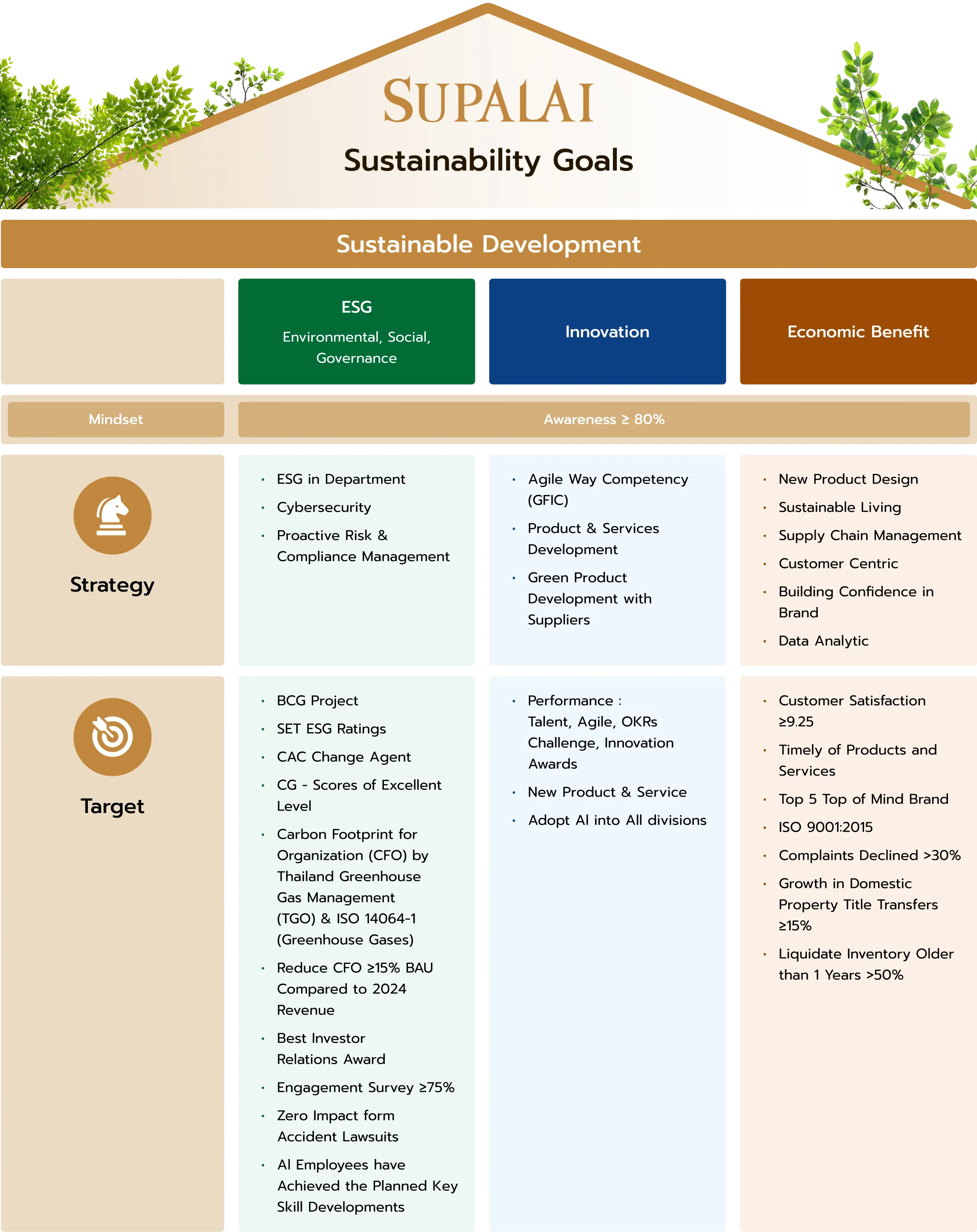
Sustainability Governance Structure
The Company drives sustainability operations by focusing on the participation of all sectors within the organization, from the Board of Directors and executives to operational staff. Therefore, a comprehensive governance structure for sustainability operations and development has been established across all dimensions economic, social, and environmental to ensure policy implementation and enhance the efficiency of related operations, with annual reviews. It is the responsibility of all employees, at every level, to be accountable for and adhere to this policy, under the supervision of key stakeholders, as follows:
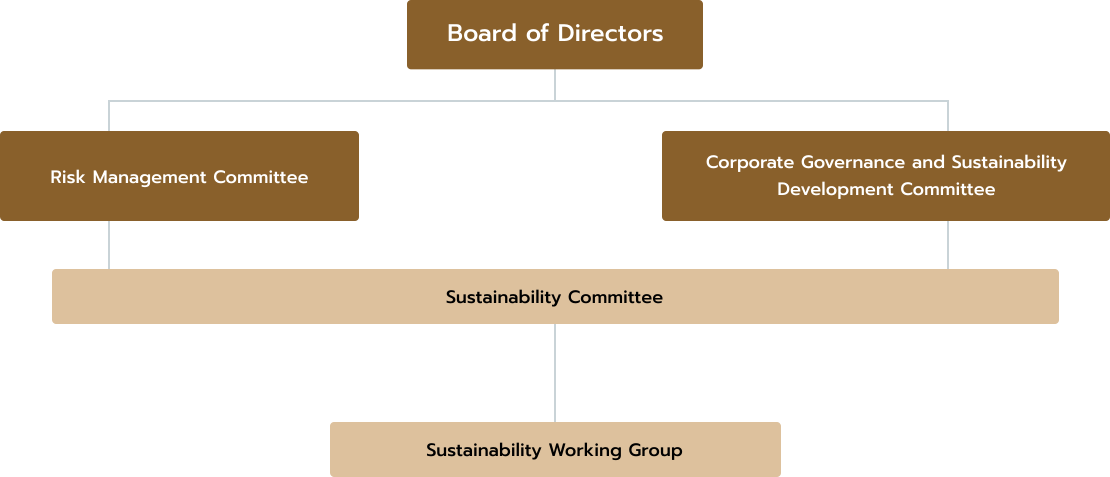
The Roles and Responsibilities of the Committee
The Company has appointed Sustainability Committee comprises the Managing Director, who is a senior executive, with Mr. Tritecha Tangmatitham, the Managing Director, serving as the Chairman of the Sustainability Committee. The Sustainability Working Group consists of representatives from department heads across all company divisions to ensure faster and more efficient management of sustainability issues in all dimensions. The roles and responsibilities of each committee and working group are as follows:
Responsible for overseeing and approving policies, setting strategic directions, and assigning the Corporate Governance and Sustainable Development Committee, in conjunction with the Risk Management Committee, to formulate strategies and practices, as well as to supervise and monitor performance annually.
Responsible for establishing policies, strategies, and frameworks for sustainability operations, covering economic, social, environmental, and governance aspects. It monitors progress and performance in sustainability, and provides appropriate advice and operational guidelines to align with the organization's goals and direction.
Responsible for establishing policies, strategies, and frameworks for enterprise-wide risk management. It monitors the progress and performance of risk management, covering environmental, social, and governance (ESG Risks), and provides recommendations for appropriate risk management measures.
The ESG Sustainable Development Committee plays a vital role in overseeing practices to ensure they align with the organization's vision and mission, as well as the Company's policies, direction, strategies, and operational goals for environmental, social, and governance matters. Furthermore, it promotes the integration of ESG operations as a part of the business processes throughout the supply chain to foster sustainable growth. and report sustainability performance to the Chairman and the Board of Directors.
Has a crucial role and responsibility in supporting and driving the Company's environmental, social, and governance operations to align with the organization's sustainability policies, strategies, and goals. This involves systematically and continuously analyzing, planning, managing data, and monitoring ESG performance to create shared value among the organization, society, and the environment, while enhancing the Company's competitiveness and sustainable growth.
