Supalai Shares Real-World HREDD Experience, Advancing Responsible Business Practices at “mHREDD in Practice: New Perspectives, New Opportunities, and Directions for Thai Businesses”
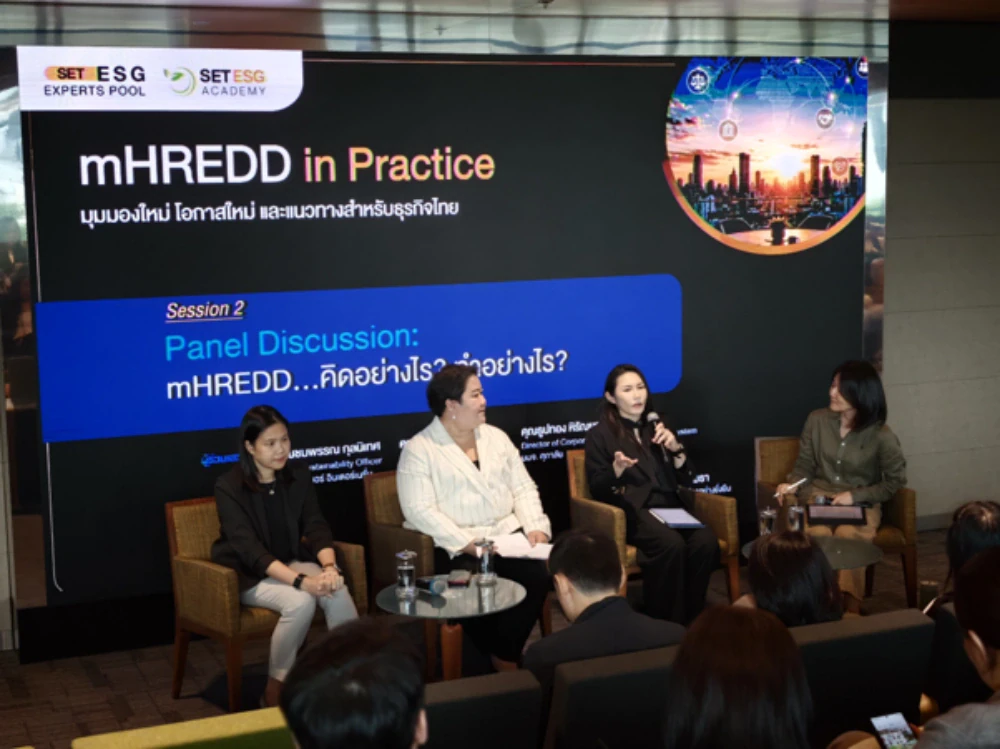
Supalai Public Company Limited shared its knowledge and practical experience in Human Rights and Environmental Due Diligence (HREDD) at the Capacity Building session titled “mHREDD in Practice: New Perspectives, New Opportunities, and Directions for Thai Businesses,” organized by The Stock Exchange of Thailand (SET) on August 26, 2026, with over 110 organizations in attendance.
On this occasion, Ms. Toopthong Hirunyanulak, Director of Corporate Governance and Quality Systems at Supalai Public Company Limited and a member of the SET ESG Experts Pool, was invited to participate in the panel discussion. She shared practical insights from Supalai’s business experience on human rights and environmental due diligence, risk scoping and prioritization, and risk management across suppliers and stakeholders throughout the value chain. Her perspectives highlighted the importance of integrating HREDD into business processes to strengthen responsible business practices, enhance risk resilience, and create sustainable value across the entire value chain.
From Compliance to Risk Management for "People and the Environment"
Supalai highlighted the key concept that HREDD should not be viewed merely through the lens of legal compliance but integrated as a core component of enterprise risk management and business decision-making. This shifts the perspective from looking solely at "risks to the organization" to considering how corporate activities and decisions impact rightsholders and the environment.
In the real estate sector, rightsholders and stakeholders span multiple segments of the value chain—including employees, construction workers, contractor labor, suppliers, vendors, customers, and surrounding communities. Consequently, risk assessment must be linked directly to actual business processes, ranging from project design and development, procurement, and construction management to handovers and community impact mitigation.
Connecting Human Rights and Environment Through Real Impacts.
Another vital topic discussed was linking environmental risks to human impacts. Many project-related impacts may originate from the environmental dimension but can subsequently spill over into human rights and quality-of-life dimensions.
For example, construction dust and noise can affect the health and quality of life of workers and nearby communities, while water management and drainage systems directly impact community health, property, livelihoods and overall well-being.
This approach helps the organization move beyond simply asking, "Are we compliant with regulations?" to asking, "Who is affected by these impacts, how severe are they, and are our existing measures sufficient to prevent or mitigate them?"
Building a Risk Culture and Expanding Value Chain Collaboration.
Supalai also emphasizes embedding a Risk Culture focused on people and the environment within daily operational processes. This encourages business process owners to actively participate in identifying, preventing, and managing impacts related to their respective operations.
This mindset extends to collaboration with suppliers, contractors, and subcontractors across the supply chain. It ensures that risk management regarding social issues, human rights, safety, and the environment goes beyond internal boundaries to foster continuous collaboration throughout the value chain.
Additionally, grievance mechanisms and stakeholder engagement serve as an Early Warning System, enabling the organization to detect risk signals early and utilize feedback to review control measures and operational workflows.
From Risk Management to Business Value.
Supalai believes that effective HREDD must go beyond risk prevention. When incidents or impacts occur, the organization must be able to respond, stop or mitigate harm, listen to affected parties, provide appropriate remediation and grievance resolution, and convert key learnings into system improvements to prevent recurrence.
Such learning can be leveraged to refine operational processes, foster partner collaboration, and drive innovations that serve business, social, and environmental goals—reflecting the evolution from:
Risk → Culture → Collaboration → Innovation → Business Value
Participating in this event highlights Supalai's commitment to promoting a business model grounded in human rights respect, environmental stewardship, and active stakeholder engagement. By continuously applying and developing HREDD principles within its business operations, Supalai aims to drive corporate growth while delivering long-term sustainable value to stakeholders and society.
“HREDD beyond compliance means transforming risk into culture, turning culture into collaboration, and leveraging that collaboration into innovation and new business value.”
