Enterprise Risk Management (ERM)
The Company continues to expand its real estate projects nationwide, resulting in exposure to a wide range of risks such as economic, political, social, cultural, legal, natural disasters, and changes in technology and consumer behavior. In particular, economic uncertainty and the rapid spread of online communication have emphasized the need for the Company to manage risks comprehensively.
The Company has adopted the COSO ERM 2017 framework and established both a Business Continuity Plan (BCP) and a Disaster Recovery Plan (DRP) to prepare for various emergencies and minimize disruptions caused by events such as natural disasters or cyberattacks. In addition, the Company places strong emphasis on cultivating a risk culture across all levels, ranging from the Board of Directors and management to frontline employees, focusing on systematic risk assessment, analysis, and management processes. Dedicated task forces are also in place to respond to emergency situations, ensuring the organization can effectively assess, respond to, and recover from crises.
Strategic and Business Risks
1. Emerging Risks that May Impact the Company’s Operations in the Next 3–5 Years
1.1 Changes in national income structure and demographic trends that may influence consumer behavior and demand
Thailand is facing structural challenges related to household income, which has been increasing at a slower pace than housing prices, resulting in an imbalance in purchasing power. At the same time, the country is experiencing demographic shifts, including the transition into an aging society and a declining population in the 30–49 age group. These issues have led to changes in consumer behavior that may significantly impact businesses. Consumers are increasingly prioritizing well-being and health, both in caring for elderly family members and in preparing for their own post-retirement lifestyles. These factors have become key considerations when choosing a place to live in today’s housing market.
The real estate development business particularly residential projects, which are among the essential basic needs of life, may face risks from shifts in consumer behavior if it fails to adapt to the country’s changing demographic landscape and the growing proportion of elderly citizens. Therefore, the Company recognizes and places great importance on these emerging changes. It has expanded its real estate development projects nationwide to reach a more diverse customer base. Currently, the Company has expanded its projects to more than 29 provinces and has incorporated Universal Design concepts to support the diverse lifestyles of all residents, across all genders and age groups. This includes single detached houses, semi-detached houses, townhomes, and condominiums that cater to various usage needs and lifestyles. Examples include Pet-Friendly homes designed for pet lovers, private space configurations tailored to modern living and enabling LGBTQ+ couples to apply for joint home loans. The Company also develops homes that support an aging society, such as the Suphavanthalai Project, which utilizes materials and interior designs suitable for elderly residents.
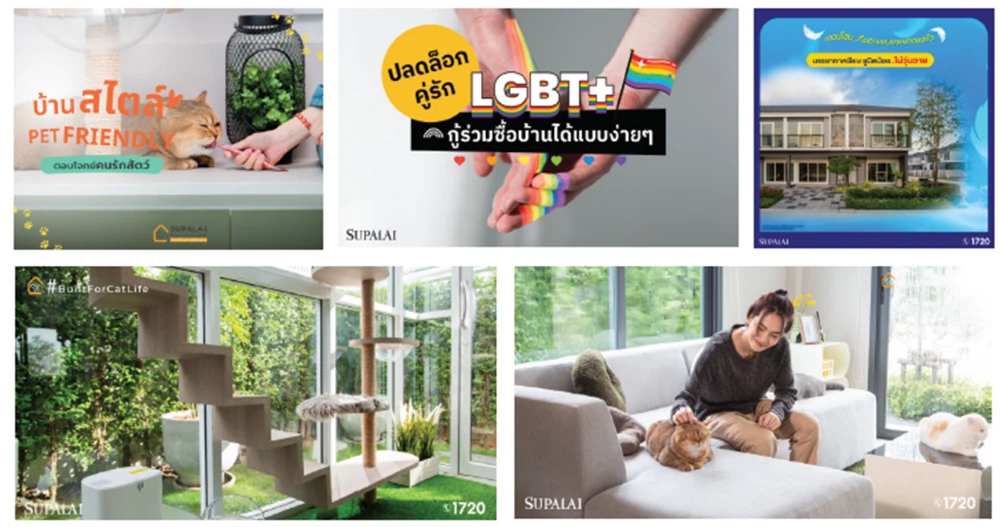
In addition, the Company designs and constructs its projects with a strong focus on enhancing the quality of life for both residents and surrounding communities, offering high-quality products at affordable prices. The Company also continuously develops multiple channels for customer communication and services, such as online reservation systems for houses and condominiums, and the development of the Supalai Sabai application, which creates a new living experience for residents and better aligns with modern lifestyles. Furthermore, the Company places great importance on understanding customer needs and continuously improves its products to ensure they meet evolving consumer behaviors in both the short and long term. Market research and technology studies are conducted to integrate innovations into design and construction processes. As a result, the Company’s products effectively meet customer needs while offering excellent value for money.
1.2 Environmental Risks: Climate Change and Natural Disasters Affecting Building Structures
The Company recognizes the macro-level risks posed by climate change, which may impact business operations in areas such as construction costs, material availability, and the stability of project ecosystems. These risks include drought, storms, floods, and uncertainties regarding government policies related to environmental laws and greenhouse gas emission regulations. To enhance preparedness, the Company has adopted the climate risk reporting framework in line with the Task Force on Climate-Related Financial Disclosures (TCFD) and developed both a Business Continuity Plan (BCP) and Disaster Recovery Plan (DRP) to strengthen resilience in responding to and recovering from emergencies.
Climate-related risks are considered significant at both the international and national levels, with increasing attention from both the business sector and the general public. The impacts of climate change are becoming more evident, such as widespread flooding due to heavier rainfall, rising sea levels from polar ice melt, and extreme heat waves. These challenges have urged countries worldwide to prioritize climate management with the goal of controlling global warming, the root cause of climate-related disruptions. The real estate development sector is particularly vulnerable to climate change, as the increasing frequency and severity of climate-related events may impact construction projects. In accordance with TCFD guidelines, climate risks can be categorized into both Physical Risks and Transition Risks, such as
- Designing residential units and adopting new construction materials to withstand extreme weather conditions, severe storms, increased air pollution, heavier rainfall, flooding, earthquakes, and other climate-related impacts.
- Construction delays and disruptions, which may lead to higher costs and delays in product delivery to customers, potentially affecting the Company’s reputation and corporate image.
Therefore, the Company has implemented management measures to help mitigate the impacts of climate-related issues while managing risks and business opportunities. The Company has set a target to reduce its carbon footprint by 40% by 2030 and established this commitment as a corporate strategy and as part of each department’s Objective Key Results (OKRs), ensuring collective efforts across the organization to reduce greenhouse gas emissions released into the environment.
In 2024, the Company received several certifications and awards related to organizational-level greenhouse gas reduction, as follows:
- ISO 14064-1:2018 International Standard for organizational-level greenhouse gas emissions quantification and reporting.
- Certification from the Thailand Greenhouse Gas Management Organization (TGO) for disclosing the Company’s carbon footprint for organization report (CFO).
- Low Carbon Reduction Honorary Award for being a real estate Company that selects low-carbon, green construction materials.
- Green Mission Award from TOA for jointly developing innovations and choosing environmentally friendly construction materials.
- Energy Efficiency Label No.5 Certification (Building Design Assessment) from the Electricity Generating Authority of Thailand (EGAT).
- Etc.
Additional climate-impact mitigation activities undertaken by the Company in 2024 include:
- Developing innovations to reduce construction waste, such as mixing finely ground lightweight brick debris with soil for planting trees.
- Using plastic pallets instead of wooden pallets to allow reuse and circulation.
- Collaborating with partners to create “Sustainable Design” eco-friendly home decoration innovations.
- Working with TOA to develop paint that reduces the need for multiple coating layers and does not require primer.
- Conducting the “Forest of Happiness” reforestation activities to celebrate Supalai’s 35th anniversary Phase 1 in Pathum Thani Province and Phase 2 in Prachuap Khiri Khan Province.
- Implementing technologies in production and product design processes that reduce greenhouse gas emissions.
- Developing green housing innovation projects.
- Installing Solar Roof systems at sales offices, construction offices, and show units.
- Continuously selecting construction materials with environmental certifications and eco-friendly attributes (Green Products).
- Implementing the “Supalai Creates Good” initiative to promote environmental improvements.
- Expanding the installation of EV Chargers.
- Participating in the “Care the Bear” program, encouraging all departments to reduce their carbon footprint—for example, by reducing electricity consumption, paper use, and plastic use in meetings.
Risk Management in Response to Increasingly Frequent and Severe Climate Change Impacts That May Affect Construction Projects.
- Residential design and adaptation of construction materials to withstand extreme weather conditions
- Designing products and construction processes to accommodate extreme climate conditions, such as applying Green Design principles, using lightweight concrete blocks and green-tinted glass to keep homes cooler, or elevating land to an appropriate level to mitigate flood risks without affecting surrounding communities.
- Organizing internal innovation competitions (Innovation Award) and implementing Agile work practices to develop approaches that “help reduce the impacts of future climate change”
- Etc.
- Construction delays or disruptions that increase costs and affect timely delivery to customers
- Preparing a Business Continuity Management (BCM) plan to ensure readiness for natural disasters that may disrupt business operations
- Etc.
With its proactive approach and comprehensive environmental integration, the Company has been able to mitigate climate-related risks and significantly enhance its corporate image in the eyes of investors and stakeholders.
1.3 Supply Chain Disruption Risks that May Have a Significant Impact on the Business
Supply chain disruption, whether from raw material shortages or delays within the supply chain, has shown an increasing trend, particularly for businesses that rely heavily on global supply networks. Key risk factors under the current situation include;
- Shortages of raw materials used in the production process, particularly those sourced from countries involved in armed conflict
- Closure of maritime shipping routes due to war, geopolitical tensions, or international conflicts (e.g., the Israel–Hamas conflict or potential conflicts involving major trading partners that are difficult to forecast)
- Disruption of major sea freight routes caused by environmental issues, natural disasters, climate change, “global boiling,” or El Niño, which may reduce water levels and prevent cargo ships from passing
- Growing polarization between global superpowers
- Escalating trade wars, trade barriers, and economic sanctions
- Emerging infectious diseases
Risk Management Measures Implemented by the Company to Mitigate Supply Chain Disruption Risks
- Monitoring changes in the raw material market and closely tracking situations that may affect procurement, such as material prices, delivery lead times, and potential shortages, to allow timely adjustments to purchasing and inventory plans
- Planning ahead by sourcing alternative suppliers to mitigate disruptions from primary suppliers, thereby diversifying risk and improving procurement resilience
- Increasing domestic sourcing by identifying local suppliers to ensure sufficient material availability and reduce dependency on imports that may be affected by external risks
- Establishing price control standards through a system that monitors and compares imported raw material prices with market data, supporting purchasing decisions and advance contracting to help control cost volatility
- Managing supplier and ESG-related risks by assessing supplier stability, delivery reliability, and ESG performance, while strengthening long-term relationships and entering long-term contracts with key suppliers to ensure a stable supply of materials needed for operations
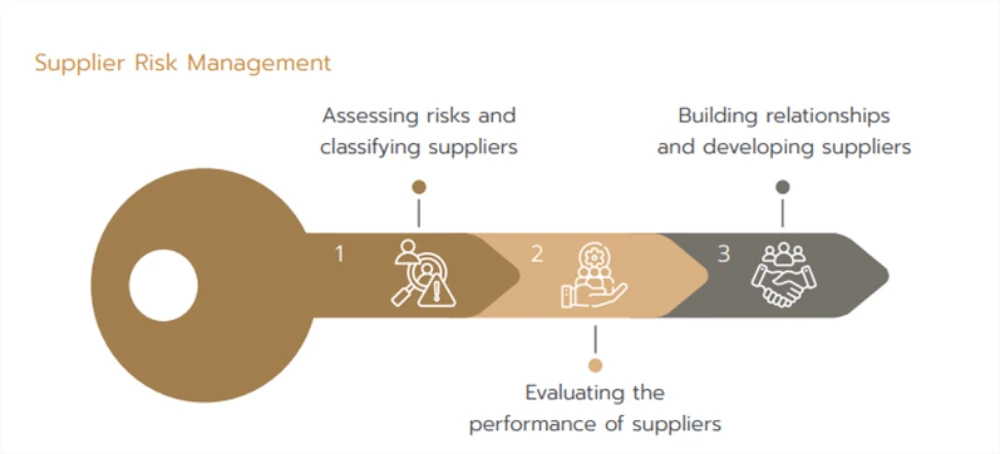
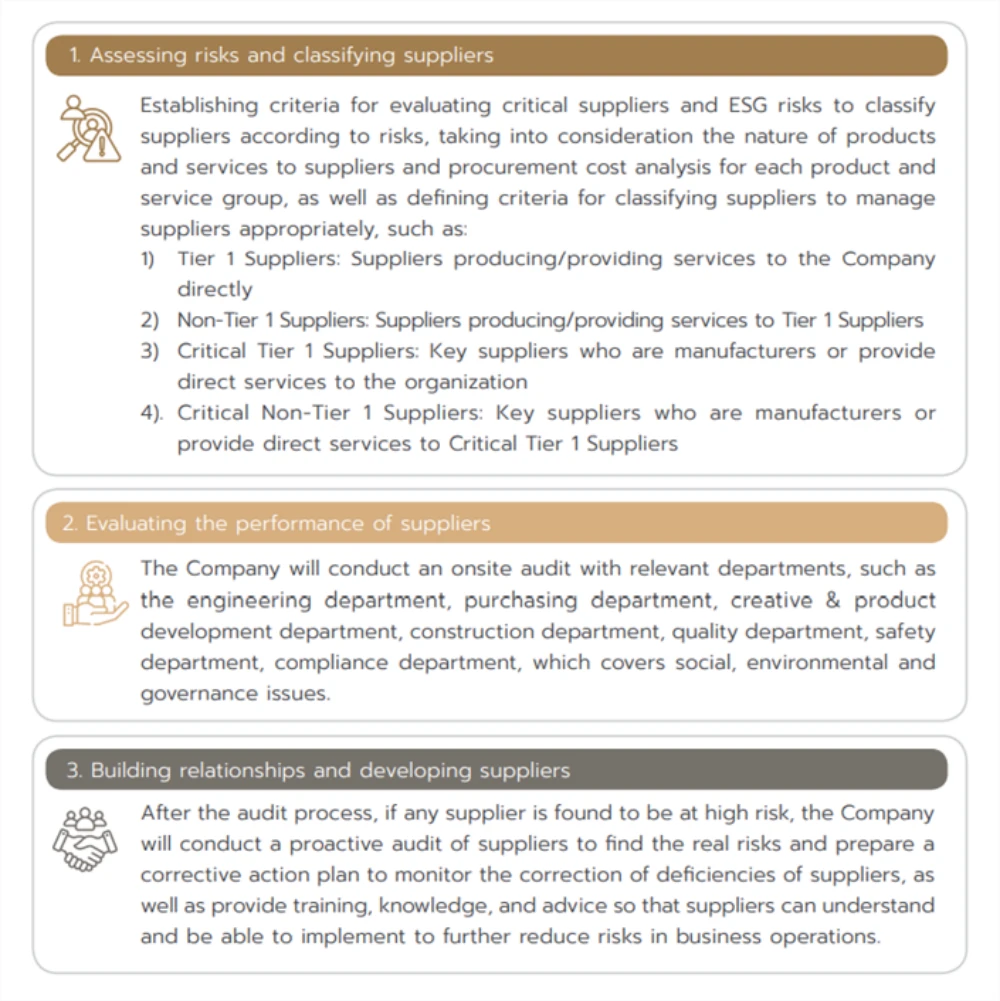
2. Procurement Risk Management
The Company continuously manages procurement-related risks by analyzing suppliers and developing a robust supplier database to support fluctuations in supply and demand, while minimizing potential disruptions in the supply chain. This is particularly important as the Company operates development projects across more than 29 provinces nationwide, requiring ongoing procurement of construction materials and services from local suppliers.
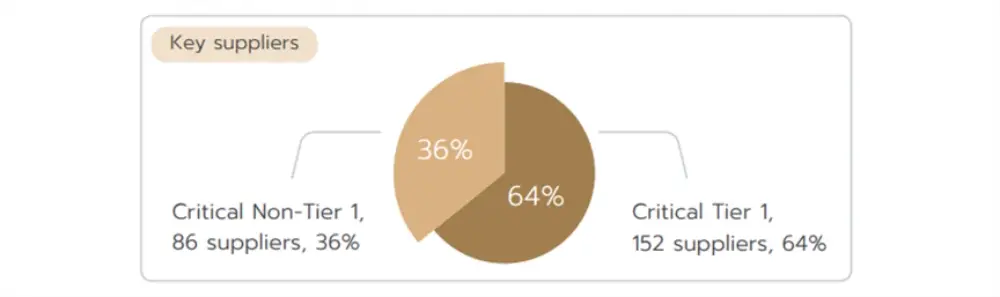
Classification of Key Suppliers. The Company categorizes its key suppliers into two main groups:
- Critical Tier 1 Suppliers: Suppliers that engage in direct business with the Company and have an annual purchase value of at least 5 million baht, accounting for 64% (152 suppliers) of total key suppliers.
- Critical Non-Tier 1 Suppliers: Suppliers that do not transact directly with the Company but supply goods to the Company’s Tier 1 suppliers, accounting for 36% (86 suppliers).
Risk Management Approaches
- Continuous supplier sourcing and development has resulted in an increase of 117 local suppliers across more than 29 provinces where projects are being developed. This helps the Company mitigate procurement risks and ensures timely delivery of goods in response to operational needs.
- Prepare updated product pricing and contractor service rates every three months to ensure construction costs reflect current market values. This promotes fairness for the Company’s suppliers and contractors, enhances the accuracy and efficiency of the procurement process, and ensures timely delivery of materials for operational use.
- Advance bidding for product prices and the use of Group Bidding principles to prevent shortages or delivery delays, enabling suppliers to plan their production and indirectly helping to control the Company’s costs.
3. Risk Arising from Changes in Customer / Consumer Behavior and Preferences
Today, many businesses are increasingly adopting innovation, resulting in rapid advancements in smart devices used in everyday life. This has accelerated changes in consumer behavior across multiple areas such as the increased use of technology in daily living, working from home instead of at the office, communicating through online channels rather than in person, and performing various transactions, including financial transactions and shopping—through applications instead of visiting banks or shopping malls. In addition, the shift toward an aging society also influences changes in consumer behavior, as elderly individuals tend to spend more time at home rather than participate in outdoor activities. Consequently, consumers are placing greater importance on factors such as usable living space, the functionality of common areas, safety, and natural surroundings that support comfortable living—both inside the residence and within the project and neighboring areas.
The real estate development business is among those significantly affected by changes in customer and consumer behavior, particularly regarding residential purchasing decisions. As a result, developers must continuously review their marketing plans and enhance their products to meet evolving customer needs.
Company Initiatives to Respond to Changing Consumer Behavior
- Closely monitor and research consumer behavior by conducting consumer behavior surveys to support the design of products and services that align with modern lifestyles.
- Design residential properties to suit new lifestyles by providing a “work-from-home corner,” planning building layouts that utilize natural ventilation and daylight, installing face scan systems to reduce physical touch, and adding delivery drop-off points separated from residential areas.
- Apply innovation and technology (Smart Living) by incorporating Home Automation concepts into product design, enabling residents to connect smart technologies within their homes in the future.
- Support the elderly and modern consumers by designing projects suitable for “senior residents” who require safe living spaces, friendly environments, and convenient functions, with emphasis on interior usable space and beneficial common areas.
- Adjust marketing strategies and strengthen brand image by increasing the focus on online channels and developing the brand to respond to consumer behavior shifting toward digital and convenience.
4. Risks arising from changes in the business operations of suppliers within the supply chain
With the real estate development industry shifting toward a “low-carbon society,” driven by government policies, international regulations, and rising consumer expectations, the Company recognizes the need to manage risks within its supply chain, such as building materials, furniture, and construction contractors, to ensure that the Company and its business partners can operate sustainably together. The key approaches are as follows:
- The Company places importance on monitoring structural changes in the industry, particularly risks from new regulations and pressures from public policies that support a low-carbon society, such as carbon taxes or requirements for reducing GHG emissions, which may impact the Company’s supply chain if suppliers are unable to adapt in time.
- The Company not only improves its internal processes but also “joins forces” with suppliers, contractors, and service providers to combine strengths and co-develop innovations. This includes the use of environmentally friendly construction materials, reducing construction waste, and developing projects that align with ESG principles to gain competitive advantage.
- The Company supports the transition of the supply chain even though industries within the chain—such as construction materials, furniture, or building systems, are still in the transition stage and may adapt more slowly. The Company continually encourages this transition through policies, environmental standards in procurement contracts, and by providing sustainability trend information.
- The Company manages risks proactively with the understanding that delays in supplier adaptation may affect project quality and the Company’s ESG image. Therefore, the Company continuously assesses the ESG risks of suppliers and provides ESG-related training to ensure their operations align with the Company’s ESG goals.
Operational Risk
1. Risk from Data Security, IT Systems, and Cyberattacks
With the rapid advancement of technologies used for data transmission and wireless communication devices such as computers, laptops, and smartphones businesses are increasingly dependent on technology and online transactions. This has led to exponential growth in online activities which, while creating significant business opportunities, has also attracted cybercriminals seeking to exploit high-value global digital transactions. Although the Company does not engage in a large volume of critical online transactions with customers or stakeholders, any data breach or cyberattack that damages systems or databases could cause significant harm to data owners and temporarily disrupt business operations.
Therefore, the Company has implemented Cloud Computing technology to manage critical system databases, selecting service providers with globally recognized security and reliability standards. Additionally, the Company has established procedures and processes to reduce risks of cyberattacks arising from internal human error or potential data leakage, including:
- Establishing IT usage policies to comply with security standards, such as defining employee access rights to information based on authority and responsibilities.
- Conducting continuous assessments of cybersecurity threats and defining appropriate mitigation measures.
- Using Cloud Computing technology that enables rapid data recovery in unforeseen events, ensuring continuity of business operations in the event of a cyberattack.
- Implementing Firewalls and VPNs to minimize the risk of external attacks and data leakage.
- Conducting tests and managing IT system vulnerabilities to analyze, monitor, and report abnormal incidents, enabling timely corrective actions.
- Requiring external contractors to complete self-assessment forms related to IT and cybersecurity risks to ensure that outsourced services are secure and adequately managed.
- Promoting cybersecurity knowledge and awareness among employees at all levels, including the potential for data leakage under various work-related scenarios.
- Conducting cybersecurity awareness testing programs, such as the Cybersecurity Posture Assessment & Awareness Program, in collaboration with external consultants to assess and strengthen the Company’s cybersecurity posture.
2. Environmental Impact Risk
Over the past five years, global pressure concerning environmental issues has significantly intensified due to the increasingly evident and severe impacts of climate change. This has led both the public sector and civil society to become more aware and demanding, creating pressure on businesses to prioritize environmental impacts in all activities and to place greater emphasis on environmental sustainability. The construction and real estate development industries are among the sectors with substantial environmental risks across multiple dimensions, including impacts on natural ecosystems, alterations to wind and sunlight patterns, the generation of dust particles, and greenhouse gas emissions. As a result, these activities are subjected to regulations and requirements from government authorities and independent agencies to ensure proper operational practices. In addition, there is a high likelihood of disputes with neighboring communities, which may lead to construction delays or suspension due to lack of permission from authorities, or lawsuits from affected communities, potentially resulting in compensation payments and damage to the Company’s sustainability reputation.
Therefore, the Company is committed to developing high-quality projects with minimal environmental impact. Before commencing construction, the Company prepares an environmental impact assessment report to identify potential impacts on surrounding communities, conducts public consultations, and assesses both positive and negative environmental impacts in all dimensions, along with determining measures to minimize adverse effects. This helps reduce future remediation costs after project implementation. The Company also monitors environmental outcomes after project commencement. Environmental impact assessments cover 4 key aspects:
- Physical environment
- Biological environment
- Human use values
- Quality of life values
Currently, the Company participates in the “Care The Bear” program initiated by the Stock Exchange of Thailand, which encourages employees to recognize the importance of environmental management and promotes collaboration in developing measurable actions that help reduce greenhouse gas emissions.
3. Human Rights Impact Risk
Human rights issues have become increasingly important and widely recognized at both global and national levels. With the influence of social media today, human rights topics are intensely discussed in society and affect all sectors. There have been growing demands for attention to various issues, including respect for human rights, acceptance of diversity, and freedom of action or expression, which have led to proposals for amendments to relevant laws or regulations, as well as sanctions against individuals, agencies, or organizations that violate or cause human rights violations. Human rights have therefore become a sensitive social issue, impacting legal requirements, regulatory compliance, and organizational reputation, and can affect a Company directly or indirectly through business partners or affiliates.
Since all individuals possess equal dignity and rights, the Company places great importance on human rights and has established a Human Rights Policy. The Company adopts the Human Rights Due Diligence (HRDD) framework of the Securities and Exchange Commission (SEC) as a guideline to prevent or address potential issues and to assess the Company’s human rights risks. The Company oversees internal processes to implement the policy, covering equality and non-discrimination, for example, providing benefits that cover legally recognized same-sex spouses, promoting fundamental human rights, establishing whistleblowing channels for reporting human rights violations, and communicating these expectations to business partners. To ensure practical implementation, the Company requires vendors to certify that they will not violate human rights and agree to allow the Company to include human rights, safety, occupational health, and environmental criteria in the vendor selection and evaluation process. In addition, the Company has processes to survey the needs of workers/employees of business partners to develop joint welfare improvement plans. The Company also conducts on-site monitoring of implementation progress and reports outcomes to management. Furthermore, the Company fosters and promotes awareness of human rights among employees and business partners/suppliers.
Compliance Risk
1. Risk from Changes in Government Policies and the Enforcement of New Laws or Regulations
The Company’s operations are subject to many laws, each containing complex and varying requirements that may change over time and must also comply with local regulations. Therefore, the Company must exercise caution to ensure that all project development activities fully comply with applicable laws. Failure to comply, or incomplete compliance, may lead to risks such as disputes with government authorities, restrictions on the use of land for certain types of construction, height limitations, building setback requirements, conditions for building usage, land expropriation for public infrastructure, or issues arising from amendments to laws, announcements, or regulations that become effective after the Company has acquired the land but is still in the preparation process for seeking approval.
To mitigate these risks, the Company conducts legal due diligence before commencing any real estate development project and adopts an Agile working approach by establishing a working group composed of representatives from relevant departments to gather diverse perspectives prior to project development. The Company continually monitors legal changes and maintains a legal database to ensure that its operations align with new laws and regulations at every stage of the process.
In addition, the Company places importance on internal communication regarding significant changes, including legal updates, ensuring that employees remain informed through various channels such as email, Line groups, intranet, and bulletin boards.
Furthermore, the Personal Data Protection Act (PDPA) regulates the use of personal data belonging to customers and stakeholders, such as names, addresses, and emails, requiring organizations to process such data correctly and for legitimate purposes. Non-compliance may result in legal penalties. Recognizing the importance of personal data protection, the Company has established a working team comprising relevant departments, including the Legal Department and the Digital Technology Department, to jointly define data control guidelines.
The Company also requires all employees to complete training and assessments on the Personal Data Protection Act (PDPA) to ensure adequate knowledge and understanding of the Act, enabling full compliance. Additionally, for departments handling personal data, this risk is included in each department’s risk assessment, along with defined risk mitigation measures to reduce the likelihood of future incidents.
